
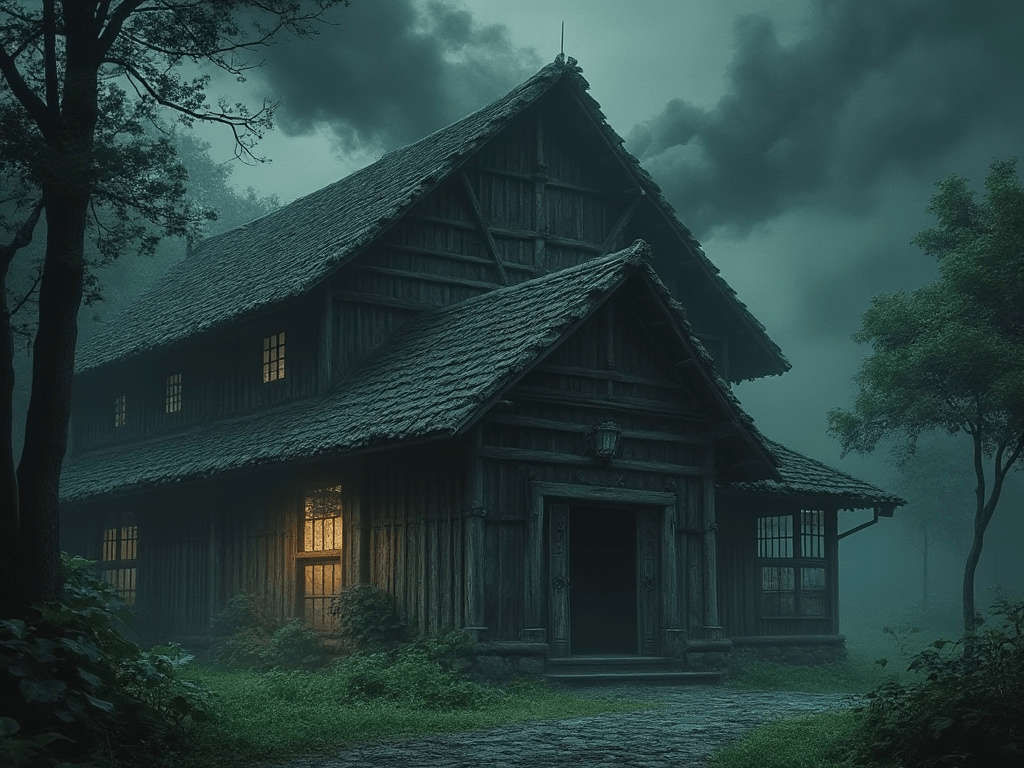
The longhouse: a symbol of shelter and community, but also a metaphor for constraint. Within its walls, every movement is monitored, every word is weighed, and every decision is shaped by the collective gaze. In a world where safety is sanctified and risk demonized, the longhouse becomes a prison disguised as a haven. Today, this dynamic permeates society, driven by an ideology that conflates care with control, community with conformity, and progress with the suppression of dissent.
The phrase longhouse has become en-vogue in recent years. Often referred to as the communal halls of many aboriginal tribes spanning from Ancient Europe to Ancient North America. Now, it takes on a socio-cultural sentiment that, in its implementation, is the nexus for our ideological ills. In this blog/essay, I would like to explore the longhouse as a cultural phenomenon, the rise of collective tyranny, and the sway of a matriarchal ethos that prioritizes emotional security over individual liberty. At its core, it asks: what is lost when we trade the wild uncertainties of freedom for the perceived comfort of perpetual oversight?
History of the Longhouse
Where does the longhouse come from? Well, it was a noun for most of our history describing a structure with deep historical roots, often serving as both a physical and symbolic center for communal living and social organization. In ancient Europe, the longhouse was a hallmark of Neolithic and Bronze Age communities, particularly in regions such as Scandinavia, Central Europe, and the British Isles. These long, rectangular wooden buildings were constructed with timber frames, thatched roofs, and wattle-and-daub walls. They typically measured between 20 and 50 meters in length and served as multi-purpose spaces for living, storage, and animal shelter. In European societies like the early Indo-Europeans or Germanic tribes, longhouses stored extended families and sometimes their livestock. They were central to agricultural villages, reflecting a lifestyle rooted in cooperation and mutual reliance. The longhouse also became a setting for governance, feasts, and spiritual practices.
In North America, longhouses were a signature architectural form of the Iroquoian-speaking peoples, including the Haudenosaunee (Iroquois Confederacy). These structures, made of wooden frames covered with bark, were built to accommodate multiple nuclear families, often related by matrilineal descent, in a communal living arrangement. Longhouses symbolized the extended family unit and served as microcosms of the larger confederacy. The Haudenosaunee (ho-de-no-show-nee) even used the longhouse as a metaphor for their political system, with the confederacy referred to as “the Great Longhouse” where all nations coexisted under one roof.
The commonalities between the two ancient histories are interesting when you consider they are examples of tribes that are vastly different from one another. Three commonalities come into clarity here.
- Communal: emphasizing collective living and shared resources.
- Social: hierarchical and egalitarian, with spatial divisions often corresponding to roles or family ties.
- Protection: overt protection of the herd, or mutual survival and cooperation.
The history of the longhouse is inherently matriarchal and gerontocratic. That is a fancy way of saying the power of the longhouse is based in the old mother. In societies that embraced the longhouse, authority was often distributed not through individual dominance or brute force, but through the wisdom of age and the nurturing oversight of maternal figures.
Within the longhouse, power flowed horizontally rather than vertically. It was less about imposing will and more about maintaining harmony, often at the expense of personal ambition or dissent. However, that is not necessarily the case. With the horizontal power structure, you still have a power structure, nonetheless, by rule in prioritizing collective security that suppresses innovation, risk-taking, and individual expression. The old mother’s gaze was not necessarily nurturing – it was watchful, maintaining an unspoken expectation that all members would adhere to the social fabric she wove. The longhouse, then, became a place of overt safety and stagnation, where the comfort of the group outweighed the aspirations of the individual.
The Modern Socio-Cultural Longhouse
My first introduction to the modern socio-cultural longhouse, the basis of this essay, came from the article titled What is the Longhouse by author Lom3Z, in the online journal First Things. The longhouse, as described by the author, is a “metonym for the disequilibrium afflicting the contemporary social imaginary”. He also describes the phenomenon of the Den Mother archetype – I connect to the Devouring Mother archetype – a pathological manifestation of maternal care, where overprotection becomes a form of domination, as outlined famously by Jordan Peterson in 12 Rules for Life. Peterson further analyzes the devouring mother as a caregiver who, under the guise of nurturing and safeguarding, stifles independence and autonomy. This maps exactly to the Den Mother of the longhouse.
With that mapping, the longhouse goes much further beyond the psychological. This modern longhouse takes the psychological components and applies them to large socio-cultural systems through generations. Lom3Z describes this as “the remarkable overcorrection of the last two generations toward social norms centering feminine needs and feminine methods for controlling, directing, and modeling behavior”. I connect this to the concept I mentioned earlier called the she wove, as in the intentional longhouse feeling, action, and narrative that is imposed on society.
The She Wove
The concept of the she wove is the method or the mode of transmission that is used to promote and instill the longhouse. Although metaphorical, it describes a process of creation, influence, or control, likening it to the act of weaving fabric. In a symbolic sense, “she wove” refers to the deliberate and intricate construction of a system, culture, or environment by a central figure – typically someone with authority or influence.
The question is not that the architect of the longhouse she wove is ‘someone’ but a group of someone’s. In this sense, the matriarchal gerontocracy of society created, implemented, and enhanced the she wove in our society. This is not to make a sex distinction to say that these are all women doing this, or an age distinction suggesting this is all 65+ individuals doing this (it’s partly that, but I’ll explain further) – rather, this is both men and women, both young and old promoting an ideal. I compare the she wove to neocosmopolitanism – something I have written extensively about – as the inherent existentialism of the world, exclusive of their elitist ideals.
“The world is a terrible place unless you follow and believe these ideals.”
– Neocosmopolitan
“Leaving the longhouse is dangerous and scary, it’s best to stay here under my control.”
– She Wove Den Mother
The longhouse is the destination and the she wove is the method and means to achieve the longhouse society. Much like communism is the destination and socialism is the methods and means to achieve a communist society. Lom3Z makes note of Greg Lukianoff and Jonathan Haidt’s Coddling of the American Mind as a definition of longhouse ideals. Furthermore, we see she wove individuals as not just being overprotective mothers – but overprotective fathers, overprotective principles and teachers in schools, overprotective politicians who need to over-legislate safety and security under the guise of doing something; overprotective doctors and psychologists who promote overtly protective measures to avoid criticism, or harm (much to the detriment of the patient or society e.g., covid); and overprotective leaders in an industry that capitulate to the society woes to ensure that everyone and anything is not offended.
Matriarchal Gerontocracy
As stated, the matriarchal gerontocracy is not necessarily sex or age-based. Now, this may seem like Derridean deconstruction, but it is the best way to describe it. This is meant to relay that all people who are perpetuating the longhouse are not just old women; however, the ethos of the longhouse is the social attribute of the old mother: nurturing yet domineering. Essentially, the nurturing comes at a price, a price of acquiescence to the power structure. One group that immediately comes to mind as members of the matriarchal gerontocracy are senior members of government. Even though most members of government are men, and may not necessarily be over 65, they adhere to the traits of this power structure.
The first personal example that comes to mind is former president Barack Obama. Sure, he may be reaching 65, but this was evident during his presidency at the age of 47. This was apparent during the 2024 election; although Obama is known for his oratorical skill, focusing on unity, empathy, and consensus-building – his emphasis on ‘brow-beating’ black men on the campaign trail is used as a tool of control and manipulation. Obama’s use of pointed criticism, especially towards specific demographic groups or in urging voter participation, can be seen as employing the ‘den mother’ methods of control where one’s moral standing or group loyalty is invoked to compel action or conformity. His critiques can be seen as a form of social shaming, which maps almost perfectly with the Longhouse’s emphasis on maintaining harmony and conformity through social pressure rather than through overt power or force.
The brow-beating is also a sign of a gerontocratic power structure of ‘shut up and listen to your senior’. It was no coincidence that during the campaign events where he criticized black men – all the black men trended younger. Perhaps a sign of good fortune, younger black men during the 2024 election rejected the longhouse ideology as 33% of black men between the age of 18-44 voted for Trump (in my mind a political manifestation of longhouse rejection).
One might ask, is this tension between younger generations and the gerontocratic power structure a new phenomenon, or is it replicable throughout time? Evidence suggests that the latter is established given that this is not just a trend that happened in the 20th century but in ancient civilizations. Philosophers like Socrates lamented the moral decline of youth, reflecting a generational divide. Similarly, in ancient China, Confucian teachings often emphasized filial piety, partly as a response to perceived youth rebellion against the established order. There are many causes of this tension, one can point to the socio-economic factors such as technological advancement, cultural change, wars, and economic recessions. Alternatively, psychological factors can cause a process of identity formation where younger generations – through natural progression and evolution – seek independence and self-definition, often positioning themselves in opposition to older generations as part of their identity-building process.
Perhaps one tool to challenge the longhouse and its matriarchal gerontocracy is the nature of rebellion which is an active reaction against the perceived authority through a desire for change, autonomy, and liberation. Two fundamental ways this can be done is through leveraging technology to decentralize authority and use satire and subversive art. This is already being done through social media and the phenomenon of memes – mainly through its low barrier of entry and amplification of less mainstream voices. The satirical use of memes on social media is an excellent lens for understanding the nature of rebellion because it reflects many of the core dynamics of resistance, critique, and subversion in the digital age.
The Longhouse Reflected
I watched the podcast with Benjamin Boyce when he interviewed Lom3Z to discuss this concept. One part of the conversation that stood out was when they were discussing why teens are not getting licenses anymore? As that used to be the first introduction of freedom and autonomy for an individual. I think the answer to that question is that the she wove – the weaving of a narrative toward danger with automobile driving, overprotection from parents, and a neocosmopolitan ideal when being told “driving a car is killing the planet, our planet, maintained by the longhouse”. It is no wonder kids don’t want to even think about pursuing that type of freedom.
I am an admirer of cinema, and when I can make connections with my writing to the art of cinema, I like to do so with great aplomb. There is a large collection of movies that relate to the rebellion against the power structure, but one that I think applies to this topic of the longhouse is Bong Joon Ho’s 2013 film, Snowpiercer. The film offers a compelling metaphor that aligns with the concept of the longhouse, particularly in its representation of a closed, hierarchical system that prioritizes collective survival over individual freedom. The train in Snowpiercer, much like the longhouse, functions as a microcosm of society, revealing the oppressive dynamics that emerge when stability and safety are pursued at the expense of autonomy and equality.
The train, like the longhouse, is a closed, self-contained environment where all members are bound by strict social roles and expectations. Movement and freedom are restricted, with each train car (or section of the longhouse) representing a rigidly defined space for specific activities and people.
The longhouse serves as the root of the allegory in Snowpiercer. It emphasizes that the train’s strict order must be maintained under the pretext of survival. The leadership justifies oppression and cruelty as necessary for the system’s stability, much like how the longhouse’s emphasis on safety and harmony can become a form of soft tyranny. Both systems, under the guise of care and protection, become mechanisms of control that suppress dissent and erode individuality. By mapping the train to the longhouse, we can better understand how collective structures, even those initially designed for survival or harmony, can devolve into oppressive regimes when they prioritize safety and order above human freedom and growth.
Deeper Psychological Reflection of The Longhouse
We have seen examples of the longhouse happen in our society in many instances. From covid to the rise of wokeness in every aspect of our society are all examples of the longhouse. Merely mentioning these issues does not explain the deeper problems of the longhouse and why it is the way it is. A deeper psychological analysis could explain why the longhouse is active and why it has been effective in our society.
Since writing my book The Interdisciplinarity Reformation in 2019-2020, I have developed a theory called the Systematic Oppression of Knowledge and Epistemology (SOKE) which highlights how institutions – namely universities with research – restrict and manipulate knowledge to maintain social hierarchies and prevent dissent. I have been applying this theory outside of academia in places such as the bureaucracy of our government and corporations, how the SOKE is something actively used to control and stifle the advancement of knowledge – to keep knowledge hermetically sealed within the power structure to maintain power. The longhouse works this way as well.
The SOKE highlights the deliberate restriction and manipulation of knowledge to maintain social hierarchies and prevent dissent. Similarly, the longhouse enforces a controlled epistemology, where the “old mother” archetype acts as the gatekeeper of acceptable thought and behavior. Furthermore, it embodies the dynamic of safetyism and epistemological oppression through perpetual stagnation. The SOKE’s feedback loop is where suppression of knowledge leads to stagnation, and stagnation reinforces suppression. The longhouse mirrors this cycle, as its emphasis on tradition and safety prevents any form of social or intellectual evolution. This creates a static society incapable of adapting to new challenges or embracing transformative ideas.
Again, this is deliberate, they don’t want you to obtain knowledge because that threatens their power structure. Another prime example is all the intelligence agencies and NGOs seethe with anger that there is a free internet and a social media space that promotes free speech. They seethe because it’s a challenge to their power structure, their carefully crafted SOKE that keeps you tuned in to their longhouse narrative. This is why they go so far as to promote legislation to shut down social media sites, limit access to information, and go as far as to get intelligence agencies involved with stifling the spread of what they call ‘misinformation’ and ‘disinformation’. Besides, we all know that misinformation and disinformation are code for speech we don’t like that threatens our power structure.
Steering back to more of a psychological analysis, what archetype of person pushes this longhouse narrative? Psychopathic? Sociopathic? Narcissistic Personality Disorder? Perhaps an amalgam of all three? Enter once again, Jung’s concept of the shadow. I have written extensively about Jungian Shadow psychology, and perhaps my bias, but it maps perfectly to longhouse ideology. The longhouse pushes inferiority because it’s the leaders themselves who do not want to show they are inferior. The longhouse pushes stagnation because it is the leader’s bureaucracy that is stagnant and unambitious. The longhouse continues to inflict its power because it is they who are deathly afraid of being powerless.
It is fear of losing control at the heart of the longhouse. The fear that the Den Mother would not be needed, that the gerontocracy is not needed and relegated to the aged and dying class, and that there is No Country for Old Men (Thanks Yeats and the Coen Brothers). This is the case, but what are the leaders going to do, roll over and die? It’s not in our nature to do this, we humans fight to the very last breath, and the longhouse structure – taking on the personification of a living being – will not draw its last breath without a fight. Which is why they continuously form and reform to keep their power structure. Truly, an existential feeling of dread from the matriarchal gerontocratic leaders, to be forgotten, to be alone, to not leave behind a legacy – it is an unfortunate foil of the human psyche.
To tie this psychology of the longhouse together, I feel the analysis encompasses both theories presented in this essay. I will say that the SOKE is merely the practice of Jungian Shadow for the Longhouse; I’ll say that again:
The SOKE is the practice of Jungian Shadow for the Longhouse
Just as SOKE projects danger onto unconventional thinkers, the longhouse externalizes its shadow by viewing outsiders—those who reject its safetyism and harmony—as threats to the system. This projection creates an “us vs. them” mentality, reinforcing insularity and stifling the possibility of dialogue or change. The longhouse’s rigid structure creates a shadow of suppressed desires, dissent, and individuality. This shadow grows in the form of passive aggression, covert rebellion, or stagnation, as those living under its control are denied the chance to confront and integrate their own drives. The longhouse, by prioritizing stability, becomes blind to the chaos lurking beneath its surface, ensuring that its eventual collapse is catastrophic rather than transformative.
Both the SOKE and the longhouse serve as cautionary tales of shadow repression, highlighting the dangers of systems that prioritize control over confrontation with the unknown. Jung’s insights remind us that only by facing and integrating the shadow can we avoid the tyranny of safetyism and create systems that nurture both individuality and collective flourishing.
Conclusion
In sum, the longhouse, as both metaphor and reality, exposes a crucial tension in human societies: the balance between safety and freedom, conformity and individuality, tradition and progress. By exploring its historical roots and psychological underpinnings, we uncover a framework that perpetuates stagnation under the guise of care, suppressing dissent and innovation for the sake of stability. Yet, history teaches us that no structure, no matter how entrenched, is invulnerable to change. The longhouse, too, must confront its shadow, for it is in the integration of chaos and order that true growth occurs. As the old guard clings to its legacy, fearful of obsolescence, it falls to the rising generations to craft a new narrative – one that acknowledges the need for connection without forsaking the liberty to innovate, challenge, and thrive. The question remains: Will we choose the comfort of the longhouse, or will we dare to step into the wild, embracing the uncertainties of freedom and the promise of a world yet to be built?
“Come, my friends,
‘Tis not too late to seek a newer world.
Push off, and sitting well in order smite
The sounding furrows; for my purpose holds
To sail beyond the sunset, and the baths
Of all the western stars, until I die.”
– Ulysses, by Alfred Tennyson, 1st Baron Tennyson

 carsonbabich.com