
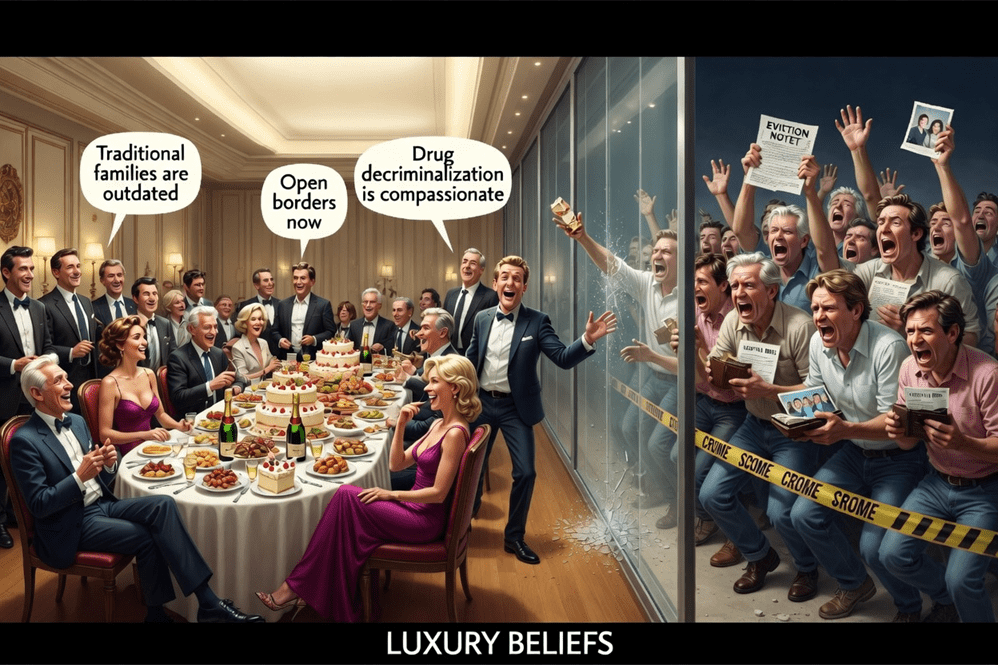
When you think of the word luxury, what comes to mind? Designer handbags, exotic vacations, perhaps a fine vintage wine. In an era of widespread material abundance, where luxury goods once reserved for the elite are now accessible to broad segments of society, traditional markers of social status have shifted, and conspicuous consumption no longer reliably distinguishes the affluent from the middle and working classes. But what about something that is not, at least physically, consumed? Instead, ideas and opinions themselves have become the new currency of distinction. This is what introduces the concept of luxury beliefs.
At their core, luxury beliefs function as a form of social signaling. They allow privileged individuals to demonstrate intellectual sophistication, moral virtue, or cultural superiority within elite circles – often at elite universities, professional networks, or affluent communities – without bearing the practical downsides of those positions. The believer remains insulated by wealth, social connections, private security, or stable family structures, while the consequences ripple outward to less advantaged groups who lack similar buffers.
This phenomenon is not merely academic; it reveals tensions in modern society about class, hypocrisy, and the unintended harms of well-intentioned advocacy. In this blog/essay, I want to define what luxury beliefs are, where they come from, and their historical and intellectual roots. Also, address the problems of luxury beliefs through socio-political cleavages, which erode social cohesion and undermine trust within institutions. By understanding luxury beliefs, we gain insight into why certain fashionable positions persist among the privileged even when evidence suggests they harm those they purport to help.
What and Where do Luxury Beliefs come from?
We can develop a prime definition of luxury beliefs as ideas and opinions that confer social status on the upper class at very little personal cost, while often inflicting tangible costs on the lower classes. Simply put, ideas that the rich can create and the poor can’t afford.
“Luxury Beliefs: Ideas and opinions that confer social status on the upper class at very little personal cost, while often inflicting tangible costs on the lower classes.”
The intellectual roots of luxury beliefs trace back to critiques of class and consumption. In 1899, economist and sociologist Thorstein Veblen published The Theory of the Leisure Class, introducing the concept of conspicuous consumption. Veblen observed that the wealthy displayed their status through wasteful expenditure and leisure, signaling economic power by affording what others could not. This evolved into a broader display of social rank, where the ability to waste time and resources marked one as superior.
Pierre Bourdieu later expanded these ideas in his 1979 work Distinction: A Social Critique of the Judgment of Taste. Bourdieu introduced cultural capital as non-financial assets like education, tastes, manners, and knowledge, which the upper classes convert from economic capital to maintain distinction. He described how elites cultivate “dispositions of mind and body” through refined preferences in art, language, and lifestyle, creating barriers to entry for lower classes. For example, it’s not enough to enter the Louvre to see the Mona Lisa; to really mark your status is to analyze it and understand it on a deeper level.
What we can surmise from Veblen’s and Bourdieu’s concepts of luxury beliefs is that they are ideas meant to distinguish the classes, creating a socio-economic wedge between the upper and lower classes. However, we don’t live in the Gilded Age anymore, and with the growth of wealth and access to information, classes seem to be blurred in the twenty-first century, or are they? This introduces Rob Henderson and his work on coining the modern term of “luxury beliefs.” In his many essays featured in the New York Times, Wall Street Journal, and The Times UK; also, in his 2024 book Troubled: A Memoir of Foster Care, Family, and Social Class, he observes that elites, insulated by wealth and stable families, promote fashionable views like defunding the police, drug decriminalization, or dismissing monogamy and traditional family structures as outdated – signalling a misplaced sophistication and virtue that is not conducive to real life.
Examples of Luxury Beliefs in Modern Society
Luxury beliefs manifest prominently in modern society through positions that elite circles celebrate as enlightened or morally superior. These ideas thrive among the affluent, who face minimal personal repercussions, while the working and lower classes absorb the consequences. Classic examples include the dismissal of traditional marriage and two-parent families as outdated or restrictive. At elite universities like Yale, students have casually claimed “monogamy is kind of outdated,” even as data consistently show that stable, married two-parent households strongly correlate with better outcomes for children in education, mental health, and economic mobility (read any Thomas Sowell book to tell you this). Elites, with their own stable families, private resources, and social networks, can experiment with alternative arrangements; poorer communities cannot.
Another prime example is the “defund the police” movement. Affluent progressives in low-crime neighborhoods or gated communities advocate reducing police funding and presence, framing it as a justice issue. Yet in high-crime urban areas, where residents lack private security or the ability to relocate, the resulting spikes in violence and disorder impose severe costs. Similarly, calls for drug decriminalization or laissez-faire attitudes toward hard drugs signal progressive sophistication. Wealthy believers can access expensive rehab, therapy, and support systems; lower-income neighborhoods suffer heightened addiction, overdose deaths, and family breakdown without equivalent buffers.
Even with these glaring contradictions from the elite class related to luxury beliefs, they can’t outwardly promote their luxury beliefs out of fear of reprisal. Comically enough, through their actions, they engage in luxury beliefs, but from a self-reflective standpoint, they are required to show disdain for the luxury beliefs that they adhere to; this closely tracks to the concept of oikophobia. Oikophobia, a term popularized by Roger Scruton in his book England and the Need for Nations, describes the reflexive repudiation of one’s own culture, history, and institutions. Elites often express disdain for Western traditions, national borders, or “outdated” norms like patriotism and cultural continuity, viewing them as oppressive. This stance confers intellectual and moral status in cosmopolitan circles but erodes the social cohesion and shared values that provide stability and meaning for ordinary citizens.
Oikophobic luxury beliefs allow the privileged to signal transcendence above their own society while remaining insulated within its protections. This mindset closely aligns with luxury beliefs because it functions as a high-status signal with negligible personal cost to the privileged. Affluent academics, journalists, and professionals in insulated environments can safely condemn Western civilization as irredeemably colonialist, racist, or patriarchal, advocating the removal of historical statues, renaming schools after founding fathers, or framing national pride as xenophobic, without facing the consequences of weakened social cohesion or eroded national identity. For them, such positions demonstrate moral and intellectual superiority within elite circles. Meanwhile, working-class communities, which rely more heavily on shared cultural bonds, patriotism, and stable institutions for meaning and security, bear the brunt of resulting fragmentation, declining trust, and cultural disorientation. Oikophobia thus exemplifies how luxury beliefs allow elites to transcend their own society rhetorically while remaining protected by its benefits.
The Epstein files illustrate a darker dimension of elite detachment. Revelations of Jeffrey Epstein’s extensive network among the ultra-wealthy, powerful figures in politics, finance, academia, and entertainment reveal how insulated elites can engage in or overlook profound moral failings and exploitation. Public outrage highlights the hypocrisy: those who lecture society on ethics, consent, and equality often operate in closed circles where accountability evaporates. This exemplifies how luxury beliefs extend beyond policy to a broader culture of impunity, where the powerful preach virtue while evading its constraints.
Canada offers a striking national case study in luxury beliefs. As a wealthy, high-trust society with strong social safety nets, Canadian elites (predominantly the Liberal Party) have championed policies such as expansive drug decriminalization experiments (e.g., in British Columbia), aggressive climate measures that raise energy costs, and open-border-friendly immigration stances framed as compassionate. These positions play well in affluent urban centers like Toronto and Vancouver, where residents enjoy high incomes and robust services. However, they frequently clash with populist concerns over housing affordability, fentanyl crises, strained public services, and cultural integration, issues that hit middle- and working-class Canadians hardest. The disconnect fuels growing political polarization, as elite discourse in media and academia drifts further from everyday realities.
Addressing Luxury Beliefs and the Psychology Around It
Luxury beliefs persist and proliferate because they elegantly solve the status anxieties of modern elites in a world where material goods no longer reliably distinguish the privileged. In insulated environments, elite universities, professional networks in media, tech, and finance, and affluent communities, individuals compete fiercely for distinction among peers who already enjoy wealth and security. As Henderson observed, this shift allows the upper class to signal sophistication, compassion, and moral superiority at minimal personal cost. From the beliefs of family, to policing and crime, all the way to elite criminal activity, confers a psychological error that has been ever-present throughout history. What can explain this psychological error?
Psychologically, luxury beliefs gain traction through a potent combination of appeal to fear and guilt by historical association. Appeal to Fear is a rhetorical and psychological tactic that exaggerates potential dangers or catastrophic outcomes to provoke anxiety and emotional urgency. It pushes people to accept certain beliefs or policies not primarily through evidence or logic, but because rejecting them is framed as leading to disaster (e.g., “If we don’t defund the police / open borders / embrace radical social changes, society will collapse into racism, authoritarianism, or climate apocalypse”). Guilt by Historical Association is a form of moral reasoning that links current ideas, institutions, or opposing views to past injustices (such as colonialism, slavery, racism, or patriarchy). It implies that anyone who defends or even questions progressive positions today shares moral complicity with those historical wrongs, thereby discrediting dissent without engaging the actual merits of the argument.
Elites heighten anxieties about systemic threats, climate catastrophe, institutional racism, or impending authoritarianism to justify radical positions as moral necessities. Simultaneously, they invoke historical sins (colonialism, slavery, systemic injustices) to taint any dissent as complicit in past evils. This rhetorical blend elevates the holder as enlightened and compassionate while discouraging empirical scrutiny of outcomes. For those buffered by class privilege, the emotional rewards of virtue-signaling and ingroup approval outweigh the downstream costs borne by others.
So, people who promote and act out luxury beliefs tend to have underlying fear and guilt, and through their own thoughts and actions, must project those fears and guilt onto others, regardless of how much it may hurt others.
Can anything be done to address luxury beliefs? Complete eradication is unlikely, as status-seeking is a deep human drive rooted in evolutionary psychology. However, greater awareness can diminish their influence. Henderson suggests that exposing the disconnect between elite rhetoric and real-world consequences, through clear data on family structure, crime trends, addiction, and cultural cohesion, helps ground public discourse. Encouraging viewpoint diversity in universities and media, prioritizing empirical outcomes over ideological purity, and fostering cross-class dialogue can reduce the echo chambers that sustain these beliefs.
Ultimately, the impact of unchecked luxury beliefs is profound: they widen class divides, erode public trust in institutions, undermine social norms that once protected the vulnerable, and fuel populist resentment. By prioritizing symbolic virtue over practical welfare, elites risk fragmenting the very society that enabled their success, leaving lower classes to navigate the consequences without equivalent safeguards.

 carsonbabich.com