

I was quite proud of myself for being as close as I could be, without any professional credentials for polling, in predicting the 2024 U.S. Presidential Election. However, Canadian politics is a whole other animal. In this prediction, I will discuss how Canadian Elections work for those unfamiliar, the key policies and themes going into this election, the party leaders vying for Prime Minister, the map and seat totals, analysis, and reasons for my decision.
How Canadian Elections Work
Canadian elections operate within a parliamentary democracy, a system that differs significantly from the United States’ presidential framework. At the federal level, Canadians elect members of Parliament (MPs) to represent their local constituencies, known as ridings, in the House of Commons. These elections determine the composition of the government and, indirectly, the prime minister. With 343 ridings across the country, each riding elects one MP through a first-past-the-post system, where the candidate with the most votes wins, even without a majority. This straightforward electoral mechanism contrasts with the U.S.’s more complex Electoral College for presidential elections.
Ridings are the electoral districts that form the foundation of the country’s parliamentary system. Officially called electoral districts, ridings are geographic areas that each elect one Member of Parliament (MP) to represent them in the House of Commons. The term “riding” originates from an old English term referring to a portion of land, historically used in Canada to describe constituencies. Understanding ridings is key to grasping how Canadian federal elections function, especially for an American audience familiar with congressional districts but not their Canadian counterpart.
So, in summation, the party with the most ridings at the end of the election, that party leader becomes the Prime Minister and forms a government, the party with the second most ridings at the end becomes the Official Opposition.
Key Policy Issues and Themes
It is no mistake that Canada is heavily influenced by the United States. Therefore, one of the key policy issues heading into this election is U.S. President Donald Trump and his policies. However, recent polling has suggested another issue (one that has been long-standing over the past 10 years in Canada) is coming back into focus: Cost of Living and Affordability. According to aggregate poll percentages, here are the Top 5 issues heading into the Canadian Election.
- Cost of Living/Affordability (36%): The rising cost of living, encompassing inflation, food prices, and general affordability, remains the foremost concern for Canadians. Polls from Global News and Research Canada indicate that voters are grappling with economic pressures that have persisted for years, exacerbated by recent trade uncertainties. The Conservatives and Pierre Poilievre have been seen as stronger than the Liberals in being capable of addressing these issues, with proposed tax cuts and housing initiatives dominating campaign promises.
- Canada-U.S. Relations/Trade War (28%): The escalating trade war with the United States, driven by President Donald Trump’s tariffs and provocative rhetoric about Canadian sovereignty, has emerged as a critical issue. This concern is particularly acute given the integrated economies of the two nations, with 30% of voters in some polls citing U.S. relations as a top priority. The Liberals, led by Mark Carney, are perceived as better equipped to handle this issue due to Carney’s international financial experience.
- Housing, Homelessness, and Poverty (20%): Housing affordability, alongside homelessness and poverty, ranks high as Canadians face a persistent housing crisis. The Financial Post and Globe and Mail report that average home prices remain elevated at $668,097, and the country is far from meeting the 3.5 million additional homes needed by 2030 to restore affordability. Pierre Poilievre has made this central to his campaign and leads on this issue.
- Economy and Jobs (19%): Economic stability and job creation are pressing concerns, particularly in the context of the U.S. trade war’s potential to induce a recession. Voters are focused on which party can diversify trade, protect industries like automotive and aluminum, and foster growth. Conservatives’ tax incentives for reinvesting in Canadian businesses reflect this priority and edge out the Liberals with their new platform limiting spending. On the other hand, Liberals intend to increase spending, causing deficits till 2029.
- Healthcare (9%): Healthcare, including access to services and wait times, continues to be a significant issue, though it has been overshadowed by economic and trade concerns. The NDP emphasizes healthcare policies, but voter attention is diluted by more immediate “pocketbook” issues. This marks a shift from years when healthcare often topped the list of voter priorities.
| Poilievre (Conservatives) | Carney (Liberals) | Singh (NDP) | |
| Cost of Living | ✔ | ||
| Canada/US Relations | ✔ | ||
| Housing, Homelessness, Poverty | ✔ | ||
| Economy and Jobs | ✔ | ||
| Healthcare | ✔ |
Meet the Candidates
 | Pierre Poilievre – Conservative Party of Canada (CPC) Pierre Poilievre, 45, a seasoned politician from Calgary, has been a Member of Parliament since age 25, advocating for low taxes and small government. His “Canada First” campaign focuses on cost-of-living issues, housing, and reducing regulatory barriers. He has garnered a strong base, especially from Private Sector Unions and young voters. Not a common demographic for Conservatives. |
 | Mark Carney – Liberal Party of Canada (LPC) Mark Carney, 60, is the current caretaker prime minister, having assumed leadership in March 2025 after Justin Trudeau’s resignation, leveraging his experience as former governor of the Bank of Canada and the Bank of England. A political newcomer, he campaigns on economic stability and navigating the U.S. trade war, but faces criticism for limited French fluency and ties to corporate interests. |
 | Jagmeet Singh – New Democratic Party (NDP) Jagmeet Singh, 46, a former criminal defense lawyer, made history as the first ethnic minority and Sikh to lead a major Canadian party in 2017. His NDP emphasizes progressive policies like healthcare and Indigenous rights, but the campaign struggles with perceptions of desperation and weaker voter commitment, though he appeals to left-leaning voters disillusioned with the Liberals. |
 | Yves-François Blanchet – Bloc Quebecois (BQ) Yves-François Blanchet, leader since 2019, heads the Bloc Québécois, a Quebec-only party advocating for the province’s sovereignty and economic interests. Known for his frankness, he pushes for Quebec’s role in trade discussions and cultural preservation, dismissing Trump’s annexation rhetoric as “jibber-jabber.” While influential in Quebec, his party’s regional focus limits its national impact, but can be influential in a minority government. |
 | Jonathan Pedneault – Green Party of Canada (GPC) Jonathan Pedneault, 34, a former journalist and human rights activist, became co-leader of the Green Party with Elizabeth May in February 2025, representing the party in leaders’ debates until the Greens’ debate exclusion due to a reduced candidate slate. Despite his youth and dynamic vision, the Greens’ 3–4% polling and strategic decision to skip some ridings hindered electoral breakthroughs. |
 | Maxime Bernier – Peoples Party of Canada (PPC) Maxime Bernier, 62, a former Conservative cabinet minister, founded the PPC in 2018, promoting libertarian values like individual freedom, lower taxes, and reduced government intervention. Excluded from 2025 leaders’ debates due to the PPC’s lack of MPs and low polling (around 1%), he campaigns in Alberta ridings, where the party saw vote growth in 2021. |
Map and Seat Total Prediction
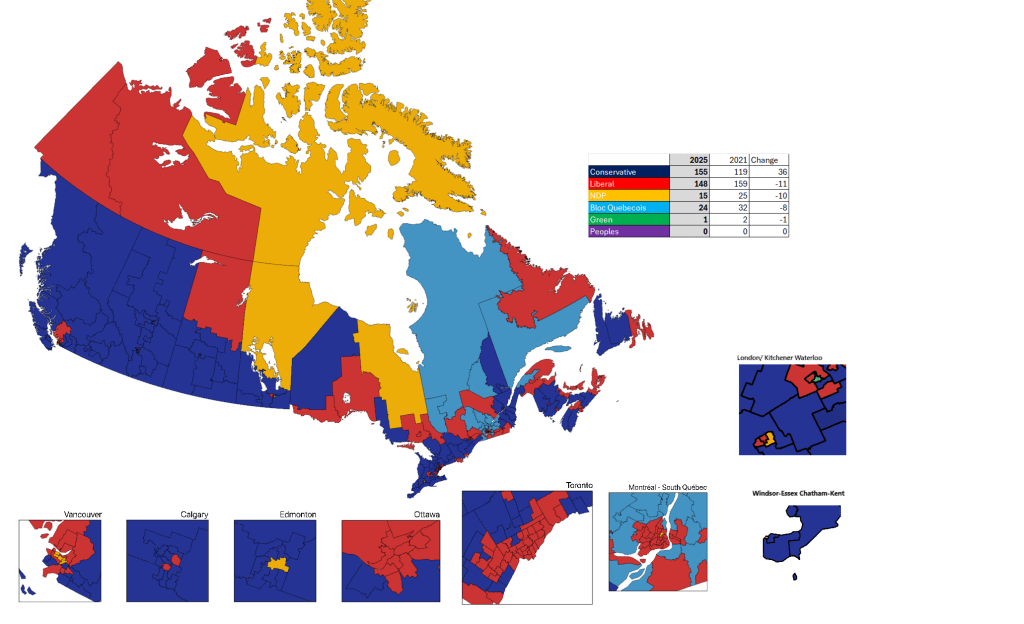
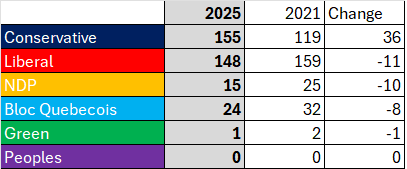
In creating this map and election outcome, I used polling data, Monte Carlo simulations, and recent election trends to predict that Pierre Poilievre and the Conservatives will win the election, but will not gain a majority in the House of Commons. With 155 seats, this is 17 seats short of gaining a majority. The Liberals will be the official opposition party with 148 seats; in third, we have the Bloc Québécois with 24 seats, the NDP drops significantly, but still maintains party status with 15 seats. The Greens keep 1 seat with both their party leaders, Pedneault and May, losing their seats – the Green Winner will be incumbent Mike Morrice in Kitchener Center.
In changes from the 2021 election, I predict the Conservatives will pick up 36 seats with strong showings in British Columbia, and an above-average performance in Ontario. The Liberals will lose 11 seats, which is not so bad considering they were the government in power during the tumultuous economic decade. Big losses from the NDP losing close to half their seats, and losses from the Bloc with a Liberal surge in Quebec. The Greens will lose one seat (Elizabeth May due to redistricting), and the PPC will have 2 elections in a row with no seats gained.
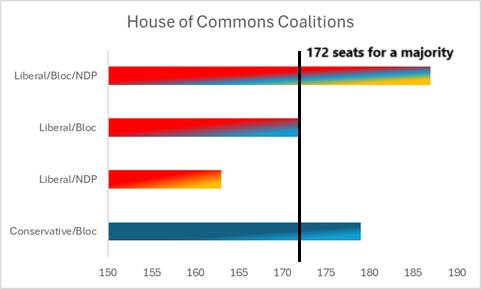
Given that it will be a minority government, one must discuss certain coalitions that will form when legislative bills come to the floor. Even with a predicted Conservative victory, Poilievre will struggle to get his agenda passed, unless he can pull Bloc MPs. For example, Poilievre has wanted to unleash the energy production power that Canada has; unfortunately, Carney, Singh, and Blanchet have promoted carbon taxes to address the “existential threat” that is climate change. The Liberals – along with the Bloc and NDP – can vote down any legislation that would promote new pipelines.
Analysis
As the 2025 Canadian federal election unfolds, several regional dynamics will serve as critical indicators of whether the Conservative Party can secure a path to a minority government. This analysis examines key electoral battlegrounds—Atlantic Canada, Quebec, Ontario, the Prairies, and British Columbia—and outlines the thresholds the Conservatives must meet to achieve victory, based on polling data and historical trends.
An early sign of a strong Conservative performance will emerge in Atlantic Canada. The region, traditionally a Liberal stronghold, holds 32 seats. For the Conservatives to signal a competitive night, they must limit the Liberals to 20 seats or fewer. Achieving this would demonstrate that the Conservatives are eroding Liberal support in a region where they typically dominate, setting a positive tone for the rest of the vote count. A failure to do so could indicate a tougher road ahead for the Conservatives.
As results roll in from Quebec, the Liberals are expected to surge ahead, potentially creating a “red mirage”—a temporary lead that may not hold as other regions report. Quebec, with 78 seats, is a pivotal battleground. Projections suggest the Liberals could secure 40 seats, the Conservatives 13, the NDP 1, and the Bloc Québécois 24. The Bloc is expected to perform strongly, capitalizing on regional identity and splitting the vote. Even if the Liberals dominate Quebec, a Conservative haul of 13 (23 total at this point) seats would keep them in a viable position for a national victory, provided they perform strongly elsewhere. The key for the Conservatives is to avoid being completely overshadowed by the Liberal-Bloc competition in this province.
Ontario, with 122 seats, is the make-or-break region for the Conservatives. To win the election, they must hold the Liberals to 65 seats or fewer. Recent polling averages show the Liberals leading with 46% support (adjusted to 50%, translating to 61 seats), followed by the Conservatives at 39% (adjusted to 42%, or 51 seats). The NDP is polling at 9% (7% adjusted, 9 seats), with the Greens and PPC at 2% and 1% (1 seat for the Greens). If the Conservatives can align with these adjusted projections—securing at least 51 seats—they will be well-positioned for a minority government. Outperforming these numbers by further reducing Liberal seat totals would significantly bolster their chances. The NDP’s role as a spoiler could also help the Conservatives by splitting the progressive vote, but the Conservatives must capitalize on their polling momentum to close the gap with the Liberals. Some key ridings to look at that may reflect the Conservatives are on the right track are:
- Aurora—Oak Ridges—Richmond Hill
- Brampton Centre
- Brampton—Chinguacousy Park
- Brampton East
- Brampton North—Caledon
- Milton East—Halton Hills South
- Niagara Falls—Niagara-on-the-Lake
- Niagara South
- Oakville East
- Richmond Hill South
- Vaughan—Woodbridge
Conservatives need to win all these seats, at the very least all the seats except 2 of the 4 Brampton seats. They have been full-force campaigning in these areas, and the polls are close. My final predictions for Ontario are that the Liberals will obtain 64 seats (52% share), Conservatives 53 seats (43% share), NDP 4 seats (3% share), and Green 1 seat (1% share).
The Prairies—Manitoba (14 seats), Saskatchewan (14 seats), and Alberta (34 seats)—have historically been a Conservative fortress, allowing the party to secure large seat counts with relative ease. However, this election presents a tighter contest. To maintain a path to victory, the Conservatives can afford to lose only 8 seats in Manitoba, 1 in Saskatchewan, and 3 in Alberta to the Liberals and NDP combined. This translates to a minimum of 43 seats across the region. Unlike past elections, where the Conservatives could afford to “let a few seats go,” they must now fiercely defend their Prairie dominance. A strong performance here is non-negotiable for a minority government, as any significant erosion of seats could jeopardize their national lead.
British Columbia, with 43 seats, is a wildcard due to recent redistricting following the 2021 census. The new electoral boundaries are believed to favor the Conservatives, particularly over the NDP, which has historically competed strongly in the province. Recent polls show the Conservatives leading by nearly 2 points, a critical edge in a region known for tight races. If the Conservatives can capitalize on these favorable conditions and win a plurality of seats in British Columbia, they will likely secure the election and form a minority government. A failure to do so could allow the Liberals or NDP to gain ground, potentially tipping the balance against the Conservatives.
Conclusion
In summation, I think it’s important to look at this election more deeply than what the polls are saying. I truly believe this election could go either way: Conservative or Liberal win. What I think is clear is that it seems like it’s going to be a minority government regardless. I could be very wrong, and the polls could be exactly right predicting a Liberal Majority, or the polls could be way off, and it could be a Conservative Majority. Given past electoral trends, incumbent advantages, and potential themes heading into the final day of the election. I am confident in this prediction. If you read my blog, I think my biases are clear: I want Poilievre to win, and I will vote for the Conservatives. There is a groundswell of support for change in this country to reverse the tumultuous Liberal Lost Decade. Or it could be that the majority of Canadians didn’t feel like the last 10 years were that bad, vehemently hate Conservative policies, and are truly fear-driven by President Trump and his actions. Regardless of the outcome, we will wake up on Tuesday, we will go to work, we will hang out with friends and family, and everything is going to be ok.

 carsonbabich.com