
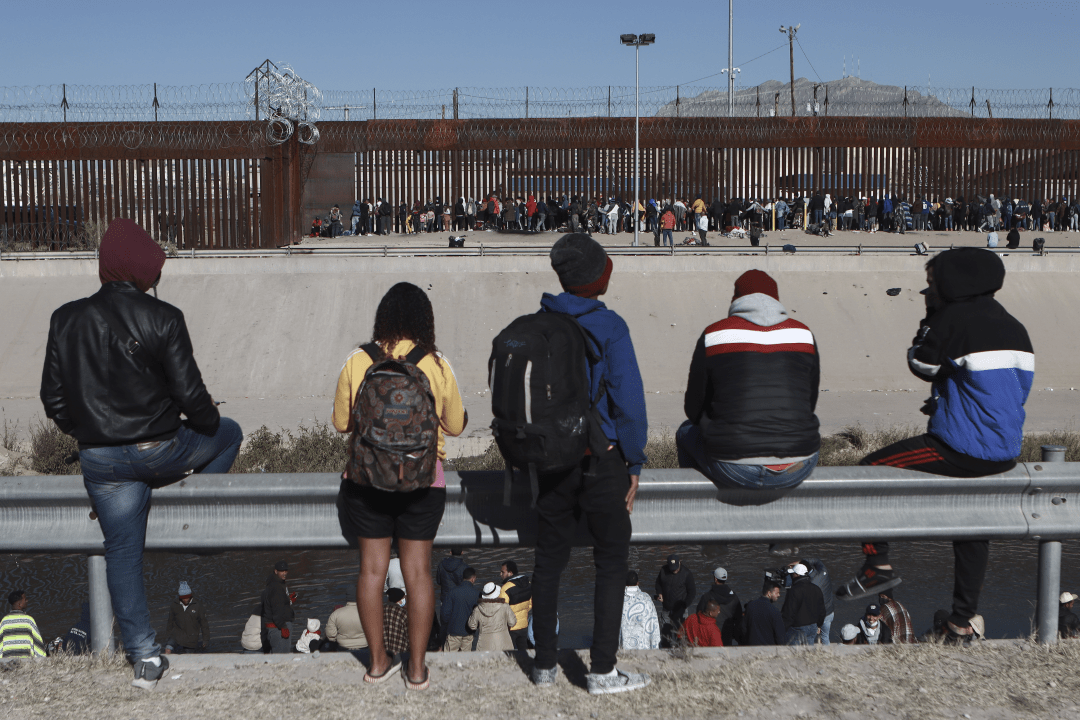
It was fellow friend and Thread Legend @Theo_TJ_Jordan who introduced me to the term Critical Immigration Theory, to aptly describe the narrative surrounding the immigration issue going on in the United States – but not just the United States – rather the entire Western world. Credit also needs to be given to @ConceptualJames a.k.a. James Lindsay who has done the work to describe the origins of the Marxian Praxis for Decolonization. We will get into this a little bit more, but I think it is best to start describing what the new narrative on immigration is, why it has been foisted into our modern political discourse, and why it is a key issue in the upcoming U.S. Election. Furthermore, why it has been an issue for public policy going back almost 20 years.
To start, in the interest of fairness, I want to be able to steel-man immigration points. For those who don’t know what steel-manning the argument is, it involves presenting the strongest, most persuasive version of an opposing viewpoint, often better than its original form, to ensure a fair and constructive engagement. The objective of this method is to fully understand and address the best aspects of the other side’s position before offering criticism or alternative perspectives. Which I plan to do.
I live in an area where there are a lot of foreign workers who work in the surrounding fields, green-houses and hot-houses during the summer. This is hard, laborious work that needs to be commended. I can say this walking in another one’s shoes as I, myself, did hard, laborious farm work when I was a teenager. Early mornings, blistering heat (at times), torrential downpour (at times), borderline freezing temperatures (at times) – sometimes experienced all in the same day, mild finger cuts from the leaf blades of corn, significant finger cuts from when you separate the husk from the stock (it’s like a sharp piece of wood filleting your finger), breathing in pesticides, strained backs, and I don’t know if you have ever been on the business end of a garden knife when removing melons, I don’t recommend it. I get it! There is a lot of hard work that legal immigrants do in our countries that help the economy immensely. But that is the operative word, legal immigration. Most of the discussion is not about the hard-working legal immigrants that come to the country on a work permit looking to send money back home to make better lives for themselves. This is a focus on the illegal immigration, or the state sponsored policies – although legal – do not help to enrich the economy but work as a protection status for certain groups.
I think immigration policy should be a robust discussion on all sides of the political spectrum – but we can never have these conversations. That is the main concern with this narrative, there is no nuance in this conversation, which has largely been inflamed by the ‘staunchly pro-immigration, liberal, professional managerial class’, who reap the benefits of the immigrant work – but wouldn’t dare walk in their shoes on the job site. You either “like all immigration” or you’re a “xenophobic bigot” – this is not healthy discussion.
The Marxian Praxis for Decolonization
Steel-manning aside, let’s get into the nitty-gritty of the conversation. I have talked about the issues relating to Canada, and university student visas being a massive failure not only for the citizens of Canada, but the exploitative nature of international students being taken advantage of by schools, corporations, and governments. Even with clear evidence showing the harms that this visa program has on the economy, the housing market, and the people (citizens and immigrants alike), the narrative is for us to have ‘compassion’ for these people. Even when I point out these policies are not compassionate on all sides they yell “BE COMPASSIONATE BIGOT!” The brain rot with this narrative leads me to believe that this is not about substantive policy discussion related to immigration, it is something much more.
Going back to James Lindsay and the origins of this narrative, we do need to go back to Franz Fanon and Jean-Paul Sartre to get a basic understanding of what decolonization is. First, as is common in my pieces, I think some definitions need to be presented. Although, most who read may know what decolonization, praxis, and Marxian analysis is, some may need a refresher.
- Decolonization: The process of dismantling colonial power structures and reclaiming culture and identity by formerly colonized peoples.
- Praxis: The practical application of theory, particularly in the context of social, political, or philosophical action.
- Marxian Analysis: A method of socio-economic analysis that examines class relations, power dynamics, and economic systems through the lens of Marxist theory.
Starting with Fanon, the ideas of decolonization are most prominently displayed in his 1961 work The Wretched of the Earth. He describes decolonization as an inherently and fundamentally “violent” and “transformative” process that not only works to dismantle colonial systems of oppression, but also the psychological liberation of the colonized. You see some key words there, “oppression”, “liberation” these are all Marxian dog whistles. Sartre in many of his words and works echoes Fanon’s analysis of decolonization. He describes it as an inherently violent revolution that must take place to liberate and free the colonized oppressed from the colonizer. Here Sartre quotes many questionable, and downright scary statements, regarding colonization.
“The colonized man finds his freedom in and through violence.”
“Europeans, you must open this book and enter into it. After a few steps in the darkness, you will see strangers gathered around a fire, get used to it: they are your brothers.”
“To shoot down a European is to kill two birds with one stone, to destroy an oppressor and the man he oppresses at the same time.”
These excerpts all come from the preface of The Wretched of the Earth. Yes, Sartre wrote the preface for the Fanon book. I don’t know what to make of the second quote, is he suggesting that all Europeans enter the darkness and fire of hell to see all their fellow Europeans there. Denoting that all white Europeans are inherently evil of some sort? It could be entering the fire, or accept the burning desire to join other comrades in decolonization, but that can be debated. The third quote is striking as it shows, symbolically (but not really), that violence can eliminate both the physical oppressor and the internalized oppression within the colonized person.
To recap, we are clearly given the analysis of how revolutionaries see decolonization. There is one group – the oppressed colonized, and another group – the oppressor colonizers, and the colonized must overcome the colonizers to liberate themselves. Where have we seen this before? Well, we have seen it in Critical Race Theory where the oppressed races must overcome the oppressor race. In Critical Pedagogy where the individual liberates their conscious from oppressive knowledge structures. Queer and Gender Theory where the queer individual must dismantle and liberate themselves from the cis-heteronormative patriarchal structure. This is all Marxian oppressor/oppressed dynamics taken largely from Nietzsche slave/master dialectic. As an aside, I think the revolutionaries get Nietzsche all wrong, but that is for another blog post.
This leads to the question, why is this happening on a global scale? Why is immigration happening on this level in all Western countries? I think it’s the narrative of compassion being used by useful idiots to promote this agenda of decolonization – because they see this self-flagellation as an inherent good. In the eyes of these supposed revolutionaries in the managerial and political class, we need to see the violence of immigrant rapes, murders, and property destruction to confront our colonizer evil. Once we feel the revolution is done, so too you will all live in harmony. I truly believe that the media not showing violent crime from immigrants is not out of incompetence, it is out of willful ignorance as they see it as “breaking a few eggs to make the world a better place.” The uncomfortable confrontation of this will bend and break you to eventually see the utopia in your future. Truly evil stuff.
Even more malicious, not only are the supposed citizens ‘colonizers’ being used as pawns in this narrative, but the immigrants also ‘the supposed colonized’ are as well. I’m not talking about the ones who commit crimes and do heinous acts, but the ones who are innocent in all this. I’m talking about the children of these illegal immigrants who did not choose violence and are products of their environment, and the legal immigrants who give newcomers a bad name. Also, this affects the areas where this immigration is happening – usually towns that suffer economically with large poor and working-class families, minority communities, indigenous communities, and natural born citizens who want to live in harmony with their countrymen and women but are being subject to a vile and divisive narrative.
This is decolonization put into praxis, or the mass immigration of illegal immigrants with violent tendencies being put into action by governmental policies. Again, I ask, why is this a key issue now, and why has it been happening for 20, or so, years? The first question is simple, we ARE being confronted with it on a massive scale and is in our political discourse. Why it has been happening is because our power structures of government, NGOs, media, and corporations want this change to happen. I leave it to the excellent videos of @everybodyshook to explain this.
***
Why are these power structures (media, corporations, NGOs, and governments) so defensive when talking about the harms of immigration and the well documented issues stemming from immigration? Because it is a strong and truthful condemnation to their perceived worldview on how to make the world a better place. No one wants to be told their wrong, especially the ones with the elitist mindset that “all immigration is a net good for what we know is a brighter tomorrow”. They want economic and socio-cultural strife in the Western World because they hate and want to change the economic and socio-cultural aspects of the Western World, and they see the influx of illegal immigration as a means to achieve that.
After 1945, the view of the elitist felt that the world is an inherently evil place and they are the shepherds to a new, kind, and prosperous world for everyone. To remove the European way of living, to a more holistic tribal nature. The praxis of decolonization and critical immigration theory is the scourge of neo-cosmopolitanism to change a world from what once was, to free ourselves from the burden, of what they see, is the natural human life, autonomy, and an embrace of tribalistic ideals over messy modern populism. The elitists say you need to embrace this new elite tribalism in order to move forward into the future, and cope with our existentialist feelings because it’s for your own good. Or how Kamala Harris puts it comically/devilishly “we need to be unburdened by what has been”, and this immigration narrative is an extension of that.

 carsonbabich.com