
Just recently, a study was released showing the harmful effects of paper straws on the body compared to plastic straws. The study found that poly- and perfluoroalkyl substances (PFAS) are more frequently found in plant-based materials, such as paper and bamboo, compared to plastic, which can have harmful consequences on our health, given that PFAS are well-known carcinogens. This is minuscule compared to the problems with cobalt on the human body – not to mention the ability to poison groundwater – to affect the human respiratory system causing damage to the lungs and skin. Furthermore, the undeniable truth is that the cobalt trade is one of the bloodiest materials in the world, mined in the Central Congo by child slaves, and sold to North American Manufacturers for items such as electric vehicles.
It is not your fault if you are naïve to this; after all, your six o’clock news barely describes these issues as they are not politically, or socially, sexy enough to make the small 30-minute window. I would wager a guess that the trial of Johnny Depp and Amber Heard got more coverage in two weeks than the cobalt mines got in two years. Or the 24/7 coverage of Donald Trump’s indictments, because he has an impact on your life and how you live. This spurned me to make yet another report on four more errors of thinking with climate activists. If you would like to see the first analysis, click here.
In my last blog report, I described the origins of climate change, the narratives put forward by climate activists (NGOs, governments, etc.), and the logical fallacies behind those narratives. This time, there will be less introductory material and we will get more into the narratives and the evidence of their falsity. In addition, provides more insight into the fallacious thinking, and the psychology around the climate activist. Why do they choose to believe falsities in the face of overwhelming evidence?
1. “Rises in temperature are a direct result of humans, burning fossil fuel, and heightened CO2.”
I think the first thing to review here is the correlation-causation fallacy. This is a formal fallacy (with a proper conclusion) but with false inferences. One study may confirm that the rise in CO2 is matching the rise in temperature – but is CO2 rise causal for temperature? You can find some funny examples of correlation-causation fallacy online, my personal favorite is the exact data correlation between ice cream sales and shark attacks, leading to someone making an inference that ice cream consumption leads to shark attacks.
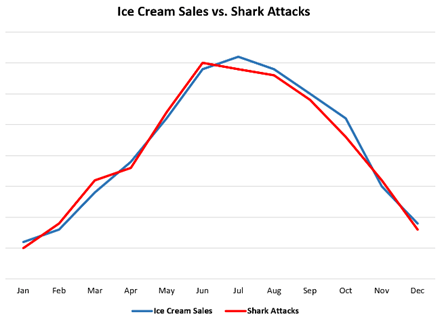
One could make a case for that, but they would run into the problem of reverse inference, such as, do heightened ice cream sales lead to shark attacks, or do shark attacks lead to heightened ice cream sales? Are sharks acquiring a taste for digested ice cream in humans, or does a shark bite lead to an increased desire for ice cream? From one corollary graph, you can deduce the inferences are absurd. Let’s try one that is a little more challenging. A study done by the Organic Industry Survey, and the U.S. Department of Education produced a graph that shows a strong correlation between Organic Food Sales and Autism.

With data like this, it would not be uncommon for a local, or even national, news source to put out a piece titled “Organic Food Linked to Increases in Autism”. But again, this is dubious as sales and diagnosis have no relationship to each other; likewise, reverse inference rules can determine that more families with autistic kids are buying more organic food perhaps? This too, is an example of correlation-causation fallacy.
Now, back to the topic at hand are the two variables CO2 and average temperature – are they direct causal links that provide a clear correlation? Authors at the Fraser Institute in Canada suggest that there are many other variables you need to consider before saying something like “Increased CO2 leads to Increased Temperature”. The Fraser Institute wanted to observe this phenomenon, and they found that there is certainly a correlation between rising CO2 and rising temperatures, but the causation is not so clear. They found that extended variables must be considered when discussing CO2 and temperature, such as atmosphere, water vapor, and methane.
The Physics Institute at the University of Bern in Switzerland recommends that we take a critical look at the catastrophizing of climate change, especially the rise in CO2 on our planet. Referencing Holly Fretwell’s book The Sky’s Not Falling! Why It’s OK to Chill about Global Warming, accepting the atmospheric changes with Carbon. Furthermore, making sense of atmospheric changes between CO2 and temperature thousands of years before human impact with fossil fuels.
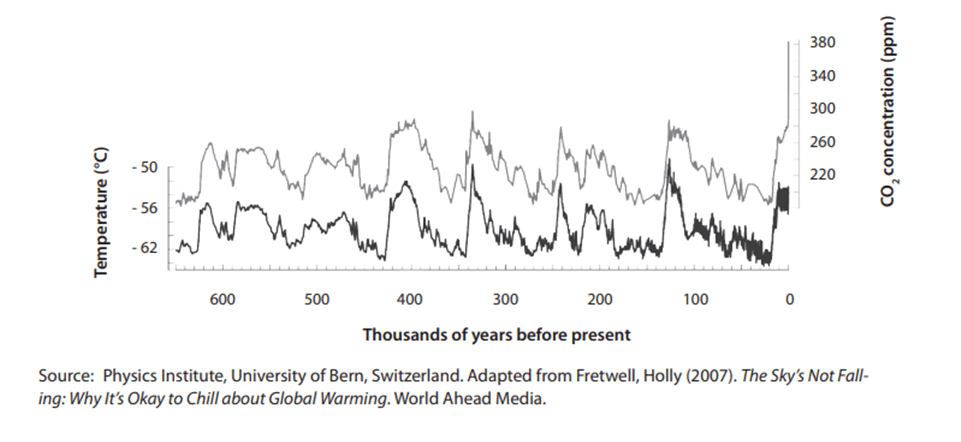
What you can see here is that temperatures and CO2 output roughly match the world population at 10,000 BC (estimated, 10 million) to 100,000 BC (estimated, 10,000 to 30,000 Homo sapiens). Now climate activists would contend that we are not early hominids anymore, we have evolved to consume more, which is true, and oddly enough the only change we see in the graph is the height of CO2 in the atmosphere and the negligible temperature change. Now, another might contend, that is only Antarctic temperatures and doesn’t represent the globe; well, it does, considering Antarctica can be a global yardstick for understanding temperature anomalies because it is a pole and it keeps a relative temperature year-round. This is opposed to a place like Toronto, which is subject to drastic changes in temperature given the Earth’s turns and wobbles on its axis, and surfaces in between the poles are subject to more or less sunlight. Hence, a place like Toronto has seasons and a place like Antarctica does not – making it a perfect test site for anomalies.
2. “CO2 is bad for the Environment!”
I struggle with this statement, as a basic grade 5 science lesson can conclude that this is not true. First, we need to outline some clear truths about what CO2 is:
- CO2 (Carbon Dioxide) is a naturally occurring chemical process that is the primary source of life on Earth.
- Plants, trees, and crops depend on CO2 for photosynthesis, meaning it is vital for the survival of plant life on Earth.
- Each human produces about 2.3 lbs of CO2 per day, per person. It is the air we expel.
Most scientists, even some climate activists, would not suggest that CO2 is all bad, but higher concentrations of it can lead to detrimental effects on the Earth. Again, if you have read my previous blog related to the climate narrative, you will see that increased CO2 levels have a minuscule effect on temperature. In addition, there is no evidence that CO2 is the culprit of hindering ecosystems or human settlements and societies as said by a lot of the climate activists. A lot of the ‘so-called experts’ are quite uninformed about CO2 and its role in our environment.
First, we have John Kerry – climate envoy to President Joe Biden, and climate activist who flies around on a private jet – once said, and I quote, “net zero is not enough. We need to remove CO2 from the atmosphere.” This is obviously not true, as removing CO2, if possible, would be the end of our civilization as we know it. Second, we can look at individuals like Al Gore and Greta Thunberg who claim doomsday scenarios with the rise of CO2, even though CO2 is still 0.04 of the Earth’s atmosphere, as previously analyzed back before the 1950s.
“I find it ironic the international color and symbols for the climate movement (green and plants) are thriving because of their mortal enemy CO2.”
It is perplexing why this narrative persists, I can’t even find a logical fallacy in it, because the opposite is true, CO2 is excellent for the environment. In an article published by Nature Magazine, through satellite observation, the Leaf Area Index (LAI, or Global Greening) has increased since 1981. Increases in fertilization and nitrogen deposition have also increased causing flora and fauna across the world to thrive. This is all because of CO2, and increased CO2 would logically make this better. I find it ironic the international color and symbols for the climate movement (green and plants) are thriving because of their mortal enemy CO2. It puts into perspective climate alarmism, especially this narrative, which has no kernel of truth – it is just flat-out wrong.
3. “Weather Events such as wildfires and hurricanes have increased in severity because of climate change.”
This has been a common statement, given the constant coverage of wildfires and hurricanes on the news. Without fail, any emergency, fires, tornadoes, hurricanes, flooding, drought, wind storms, ice storms – hot or cold, snow, rain or shine – it is all due to climate change. Not only do we have to ask ourselves is this another error in thinking/logical fallacy? Or, is this even true?
Steve Koonin, former Energy Envoy to Barack Obama, released a book called Unsettled: What Climate Science Tells Us, What It Doesn’t, and Why It Matters. A key theme in this book is the discussion between weather and climate change – and how climate activists, world leaders, and the media conflate the two topics. Koonin criticizes the tendency to attribute individual weather events (e.g., a heatwave, hurricane, or cold snap) directly to climate change, noting that weather events have always occurred and can result from natural variability rather than solely from human-induced climate change. This is accurate given that hurricanes and wildfires, for example, have decreased in actuality and severity since the early 20th century, and with the increase of fossil fuel burning.
I think the observation of weather patterns and logical thinking has nothing to do with a logical tradition at all – I think this is more of a psychological issue with people, notably our leaders. Media was quick to get on the cause of the recent Maui fires suggesting climate change. As usual, they ate their words when reports came out suggesting that the fires were a troubling concoction of failing electrical utility policies and ground management – all overseen by local and state governments.
I say psychology has a play here because many times climate change is used as an excuse to diminish the irresponsibility and incompetence of leaders. Psychologically, this relates to the tendency of blame avoidance, projection, and dysregulation of emotions, symptoms common with neuroticism and narcissism. Neuroticism is the way that one projects their negative traits (a la Jung) onto other people to deflect from themselves; narcissism is the way that it protects the individual’s ego at the behest of other people around them. Therefore, whatever it is that caused the wildfires – climate change, a forest squirrel smoking a cigarette, just don’t say it was government policy.
4. “Renewables can replace fossil fuels for net-zero emissions.”
This is more of a myth that is expanded upon by climate activists, that either soon or eventually we will need to be net-zero and our world will run on renewables. It is quite a loaded statement given that advancements in Renewable Natural Gas could be used in the future to power vehicles just as well as fossil fuels. Or that the advancement of carbon capture and nuclear will be the way to bring renewables in, but climate activists don’t like these methods. Climate activists have criticized nuclear, liquified natural gas (LNG), RNG, thorium, and carbon capture solely on the basis that they are not renewable enough. I have mentioned the cobalt mines and their importance in electric car manufacturing, but these renewables discussed (wind, solar, battery) are highly ineffective and unfeasible.
Craig Rucker – President of the non-profit Committee for a Constructive Tomorrow environmental group – has been discussing the challenges of renewables supplanting fossil fuels for some time now. He suggests that wind power, for example, is perhaps the most environmentally unstable and economically unstable renewable given the cost to the taxpayer. Not only do these costs hurt the pocketbook, but the amount of steel production and land degradation around it. An article in the Journal of Environmental and Occupational Health Policy suggests how the disposal of wind turbine blades is so unsustainable that it causes many environmental issues via methane release or hazardous off-gases in the ground hurting water supply and the flora and fauna surrounding. As for economic instability, Rucker suggests that wind production will net -2 to -3 jobs from other areas causing many problems in the economy and social instability.
The prospects are not much better for solar, given the panels are not conducive to a large economy to run given the high fail rate of solar, and the cumulative capacity toward early replacement; meaning, they are installed and trashed quicker than any other renewable. Not to mention, the economic impacts are devastating as most solar panels are made in China, if you think a net -2/3 loss is bad, more will be lost when outsourcing renewable products from other nations.
The reality is that sustaining our present consumption levels without relying on fossil fuels (like natural gas) is impossible. The notion held by liberals that energy alternatives like wind, solar, and biofuels can entirely supplant oil and natural gas is a farcical concept not rooted in any truth. It shows a fundamental misunderstanding of energy policy from people like Bill Gates who suggests ‘an energy miracle can be created with enough Research and Development’. This is wishful thinking and a false premise fallacy.
“The reality is that sustaining our present consumption levels without relying on fossil fuels (like natural gas) is impossible. The notion held by liberals that energy alternatives like wind, solar, and biofuels can entirely supplant oil and natural gas is a farcical concept not rooted in any truth.”
Conclusion
After going on this long journey, reading many papers, and analyzing many data sets – I wonder if this will make a difference. I wonder if leaders will ever change their minds on climate zealotry. The good news is they never had a favorable view of climate change and don’t support it – the bad news is they are hypocrites who want you to follow the climate edicts, just not them (rules for thee, not for me). Take Michael Bloomberg for example, his foundation provides money to the C40 organization and its role in creating sustainable cities through regulatory policy for things like less meat consumption, elimination of automobile traffic (15-minute cities), and more multi-unit housing. Of course, Bloomberg Philanthropies wants this for you, but not for Michael Bloomberg, he gets to keep his properties in New York (double-wide mansion), The Hamptons (22,000 sq foot Estate), London ($25 million property), and his many vacation homes in Bermuda, Florida, and Vail, Colorado. More multi-unit housing for you, more mansions for me.
This is not a new phenomenon in our leadership class – we saw prime examples of this during covid. In many ways, climate change and covid are quite analogous to each other in how they formed, proliferated, and how our leaders responded. The push for climate change reform is no different, largely a transfer of wealth involving governments and corporations enhancing their green portfolio for more tax dollars and assets. I don’t know when it will be, but I feel more and more people are becoming aware of this #ClimateScam house of cards, and it is doomed to fail.

 carsonbabich.com