
To start, what does the phrase “climate change” mean? Before the 1980s, more specifically, before the 1979 National Academy of Sciences study on carbon dioxide, climate change was widely discussed as “global warming” which refers only to surface warming – predominantly oceans. For many years after it was blended and ultimately reconstructed as “climate change” reflecting the overall change in the temperature of the Earth. We will get into why global warming is not the phrase used anymore, but let’s keep the focus on the phrase “climate change.” Climate Change is a logically redundant phrase considering the characteristics that make climate…well, climate, is its ability to change. The etymology of the word climate is from the Greek klima meaning to slope or lean denoting a change in movement. Thus, the word climate itself is to denote a change or a movement within a zone. Essentially, when you say climate change, you are saying change-change – an error of redundancy.
So, taking that etymology and applying it to today’s linguistic standard climate refers to the slope or change in weather patterns over a long time; and together, climate change can be the changes in that slope or change in weather patterns over a long period – I guess. Pedantic aside, this is the true statement of climate change, and it is simple, the change in weather over time. No one argues with that or disagrees that climate changes, that would be like disagreeing the Earth revolves around the Sun. However, that is not the definition of climate change according to climate activists, in which I will put the UN in that category, which defines climate change as:
“a change of climate which is attributed directly or indirectly to human activity that alters the composition of the global atmosphere and which is in addition to natural climate variability observed over comparable time periods.”
That is not the only definition provided by the UN, on its global issues tab, it defines climate change as:
“long-term shifts in temperatures and weather patterns, mainly caused by human activities, especially the burning of fossil fuels.”
Now that is quite a long distance from our original etymology of the word to just mean change, or a change in weather patterns, to add a change in weather patterns caused by humans and the burning of fossil fuels. The common disagreement between climate activists and regular people is that climate activists obfuscate and conflate the definitions. They will call a regular person a loon, saying they “don’t believe in climate change” suggesting they don’t believe that the climate changes. But they switch their definition toward their objectives of policy changes to eliminate fossil fuels, or human movement, which are two different concepts. Their argument is essentially a Motte and Bailey fallacy where they argue for the uncontroversial opinion that climate does change – again, no one disagrees with this – only to retreat to the Bailey for a ‘hard-to-defend’ opinion.
Motte: Climate change is just the change in weather
Bailey: Climate change is caused by burning fossil fuels and human interaction with the Earth, and we need policies to limit and manage these outcomes.
Now, Motte and Bailey is a fallacy because it wrongly conflates two arguments, meaning it is an error in thinking and logic, to which I will conclude: climate activists have an error in thinking and logic. I’m not being harsh, I’m just pointing out the linguistic truth. Now, I could just leave it there, but I owe it to myself and to others to point out exactly why climate activists have an error in thinking, what evidence do I have to support this? I will introduce 4 errors in thinking by climate activists, what these errors will show is an outline of narratives presented by climate activists, and the proceeding research that challenges these notions.
1. “Coastlines will be gone, and coastal cities will be underwater.”
This is a common narrative presented by climate activists, but is it necessarily true? We have earned the right to challenge this considering the false predictions – notably the famous U.N. Environmental Official who told the Associated Press in 1989 citing that “entire nations could be wiped off the face of the Earth by rising sea levels if the global warming trend is not reversed by the year 2000.” We did not ‘reverse’ according to this official and we are 23 years past Y2K, and are entire nations underwater? I think it is important to address the other topics in that piece, notably:
- “As the warming melts polar icecaps, ocean levels will rise by up to three feet, enough to cover the Maldives and other flat island nations.”
- “The most conservative scientific estimate that the Earth’s temperature will rise 1 to 7 degrees in the next 30 years, said Brown.”
- “What we do know is that we are destroying the tropical rain forest at the rate of 50 acres a minute, about one football field per second.”
First things first, I recently checked the Visit Maldives site, hosted by their tourism board, and it is still an island complete with wonderful villas, restaurants, hotels, and excursions. According to the NASA Earth Observatory, only a .5°C change happened between 1990 and 2020. Lastly, tropical rainforests, as of 2009, are expanding not depleting.
Not only is this evidence not to trust the over-zealous climate predictors as they have been mostly wrong for 50 years, but to critically look at the narrative presented before making a rash judgment. Will the coastlines be “gone?” No, they are not gone, and they are not going anywhere according to a Nature Article, where, across the world, beaches have been growing or expanding seaward at a rate of 0.33 meters per year since the 1980s. More beach means an inverse to rising oceans, perhaps even a sign of global cooling with more water freezing, becoming ice at the poles. This leads to the second error.
2. “The polar ice caps are melting at a rapid pace.”
Recent evidence seems to say otherwise, with more ice showing up in Antarctica, to the narrative pushed in my home country of Canada that ice in the Northwest Passage is rapidly deteriorating based on historic fog data and model simulations. We can thank covid for showcasing just how ‘accurate’ models are – like when Neil Ferguson in the UK predicted 500,000 British covid deaths and 2.2 Million US covid deaths in 2020 alone. Climate models are just as egregious, David Henderson and Charles Hooper from Stanford’s Hoover Institution outline how climate models are a seriously flawed science with significant measurement errors, inability to measure the Sun’s energy, and factoring cloud errors. Not to mention the bias of models, as in, models are only as good as the info put in; thus, if you hold a bias, the info put in could be biased.
“Climate models have been subjected to ‘perfect model tests,’ in which they were used to project a reference climate and then, with some minor tweaks to initial conditions, recreate temperatures in that same reference climate. This is basically asking a model to do the same thing twice, a task for which it should be ideally suited. In these tests, Frank found, the results in the first year correlated very well between the two runs, but years 2-9 showed such poor correlation that the results could have been random. Failing a perfect model test shows that the results aren’t stable and suggests a fundamental inability of the models to predict the climate.”
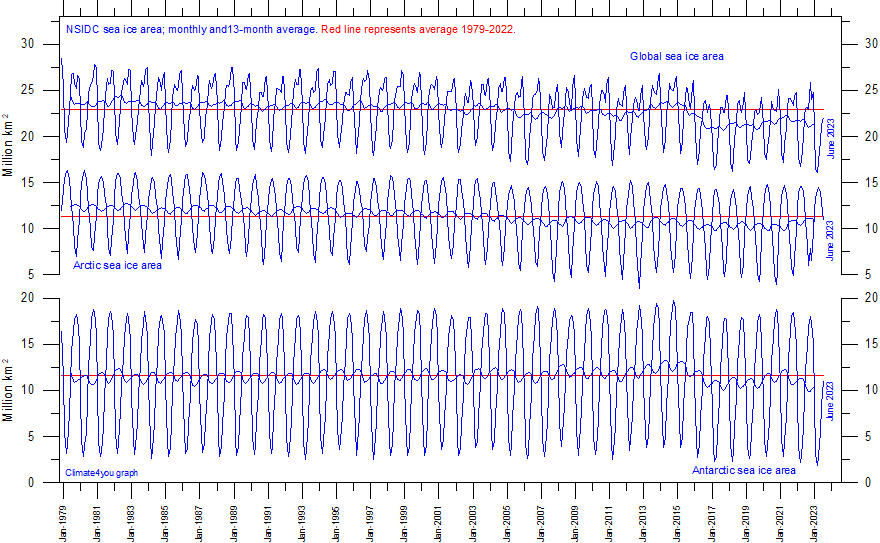
One look at the predictions concerning ice depletion at the poles, you see many dates, such as polar ice going away in 2014, or 2016, or 2018. I think it is best to look at the data of the actual ice cores from Ole Humlum, Danish professor emeritus of physical geography at the University of Oslo. Humlum uses data from the National Snow and Ice Data Center (NSIDC) at the University of Colorado which uses satellite imagery and sampling to get a clearer picture of what is actually happening with global, Arctic, and Antarctic ice. What is shown is that from January 1979 to June 2023 there has been no change in the average of sea ice globally, or at the poles.
3. “99.9% of scientists agree that climate change is solely anthropogenic.”
This is one of my favorite claims as it rests on one study that has been shared numerous times by climate activists and by government leaders. The Cornell Study Greater Than 99% Consensus on Human Caused Climate Change in The Peer-Reviewed Scientific Literature, is quite the presumptuous title, considering the data is far from it. It is almost like the climate activists just read the title and institution and assumed fact. However, looking at the results, only 3000 papers met the criteria, and only 19 of the 3000 reflected an explicit endorsement of human-caused (anthropogenic) climate change with quantification (hard data). Furthermore, 413 of the 3000 reflected explicit endorsement of human-caused climate change without quantification (without hard data); suggesting, actually, that only 14% of papers show that climate change is solely human-caused, not 99.9%.
What the authors of the study did (methods would be outright rejected in a real journal) was count the explicit rejection with quantification (4/3000 = 0.13%) and claimed this to be the evidence that 99.9% of scientists agree. However, most of the studies (2106/3000 = 70%) take no position (2104) or undefined (2) on human-caused climate change, to what the authors of the study described as:
“Does not address or mention the cause of global warming…Expresses the position that humans’ role in recent global warming is uncertain/undefined.”
Not only does this study come short in the PRISMA standard for literature reviews and meta-analysis, considering the biased search parameters (even the authors suggesting explicit rejection would be hard with their search parameters), it falls short of understanding the basic data, and almost explicitly, lying about the data. You cannot add papers that consider the null hypothesis or uncertainty of human-caused climate change as an endorsement of human-caused climate change. This paper’s conclusion is a prime example of false inference fallacy meaning an argument or conclusion that draws false conclusions from observations. Here is an example:
Person A: Do you like eating salmon?
Person B: I don’t know, I have never actually tried salmon…
Person A: Person B likes salmon.
Sure, Person B never said that they didn’t like salmon, but they never said they liked it either, you cannot just assume they would like salmon.
4. “97% of scientists agree that climate change is an existential threat.”
Again, another false inference fallacy by the climate activists that were amplified by leaders in both industry and government, including the 44th President of the United States Barack Obama, who tweeted “Ninety-seven percent of scientists agree: #climate change is real, man-made and dangerous.” As climate historian Dr. John Robson points out in his Climate Discussion Nexus, this number comes from a University of Illinois study that set out to ask two questions.
- Do you agree that global temperatures have generally risen since the pre-1800s?
- Do you think that human activity is a significant contributing factor?
Out of the 3,146 responses, only 90% said yes to the first question, with 82% saying yes to the second question. However, out of the meteorologists that were surveyed, only 64% said yes to the second question – which brings some interesting questions into the fold about the data analysis. Where the actual 97% consensus comes from is by 77 out of the 3,146 respondents who called themselves “climate experts.” Of that 77, 75 said yes to the second question, meaning 75/77 = 97%.
Never mind that 97% came from a sample of 77/3,146 = 2.4% of respondents. Another question, who were these experts? This is an appropriate question given Jose Duarte’s analysis of a 2014 Dutch study on human-caused climate change, which suggests the researchers created a “structural inflationary bias” as the study “surveyed a large number of psychologists, pollsters, philosophers, etc.” none of whom are climate experts; and that “the valid results of the study are unknown, and it should be withdrawn.” Of the 77 “climate experts,” how many are actually experts? Considering we know only 64% of meteorologists agree.
What about the concept of an “existential threat?” Well, that is not confirmed either since most studies, like the Cornell study, take a null view on the dangers of climate change and none explicitly or implicitly endorsed it as an “existential threat to humanity.” One person you can look to is Dr. Christopher Colose, a postdoc fellow at the NASA Goddard Institute for Space Studies, who states:
“Many of the nightmare scenarios, such as no more food, unbreathable air, poisoned oceans, perpetual warfare, etc. are simply ridiculous, although food security is indeed an issue at stake (see David Battisti’s comments). A “business-as-usual” climate in 1-2 centuries still looks markedly different than the current one, but there’s no reason yet to think much of the world will become uninhabitable or look like a science fiction novel.”
To think of an “existential threat” – which means a situation or phenomenon that poses a critical and imminent danger to the continued human existence – is far from the consensus of climate scientists. Even take Jørgen Randers – who is no enemy of the climate agenda, given his stance in favor of doomsday neo-Malthusianism – wrote a paper in 2020 outlining that even with the elimination of man-made greenhouse gases temperatures are still predicted to rise only .5°C from the height in 2030 to approximately 2500. Now, this is a model (of course) so you should take this information with a grain of salt, but what this is saying is that the existential dread of getting to zero emissions to “save” the planet is futile given that natural systems are going to warm and cool the planet.
An activist might say to “look at the trend line” but this is after the authors suggest a temperature plateau around 2030-2075 as natural due to “the concentration of GHGs in the atmosphere declines, and heat is used to melt on-land glaciers and Arctic ice.” With the concentration of CO2 being “gradually absorbed in the ocean surface (and later transported into the deep ocean), and (b) CO2 is gradually absorbed in the biosphere” through the natural process of photosynthesis. I think the best rebuttal to someone who says climate change is an existential threat is to say (a) no it’s not, or (b) it could be, but it is the way of the world, and there is nothing you can do about it.
***
There are more climate change narratives to discuss, which I will probably do in a future blog post; but for now, I wanted to focus on 4 key narratives of climate activists and their error in thinking related to logical fallacies. I always welcome comments, so do not hesitate to share what narratives you have heard from climate activists.

 carsonbabich.com
2 thoughts on “Observing the Narrative of “Climate Change”, and 4 Errors in Thinking of Climate Activists, According to the Scientific Research.”