
“Analytic Epistemology is the process of using formal logic and propositional logic to find truth claims relating to the nature of knowledge.”
In John 8:32, Jesus Christ addresses a group of followers and says “And you will know the truth, and the truth will set you free”. The concept of truth and freedom is important to understanding analytic epistemology – as you will see throughout this post. Seeing analytic epistemology for the first time – it is hard not to confuse it with analytic philosophy. If this is the case, good work, you are on the right track. It is out of analytic philosophy where analytic epistemology gets a host of its characteristics. With that preamble out of the way, analytic philosophy rests on two fundamental processes: formal logic and propositional logic; thus, the usage of formal and propositional logic to find truth claims related to ideas forming knowledge. So, the full definition of analytic epistemology is the process of using formal logic and propositional logic to find truth claims relating to the nature of knowledge.
For philosophy is based on a theoretical concept toward a type of knowledge, epistemology is the foundational understanding toward the nature of knowledge. Theory asks for the what, and epistemology asks for the how and why. How and why are the fundamental questions for a nature of knowledge, how does this become knowledge, and why does this become knowledge? Many can have a theory about apex predators and describe their process of hunting; however, bigger questions on how and why predators hunt are more impactful and lead to more clarity on the subject.
Key delineations are seen here – notably theoretical vs. foundational. Theory asserts an idea about a particular subject; whereas, foundation asserts the underlying basis or objective principle of a particular subject. For example, many theories can be developed on how to aesthetically and artistically design a building, but the load-bearing characteristics of beams, rivets, and dimensions are the objective foundation that is needed to build any structure. Theoretical is to concept what foundational is to the tools for the concept.
Let’s review analytic epistemology so far:
- Uses formal and propositional logic with reason and science.
- Explores the foundational, or underlying basis, and the objective principle of knowledge.
- Nature of knowledge asks how knowledge is formed and why is knowledge formed in this way?
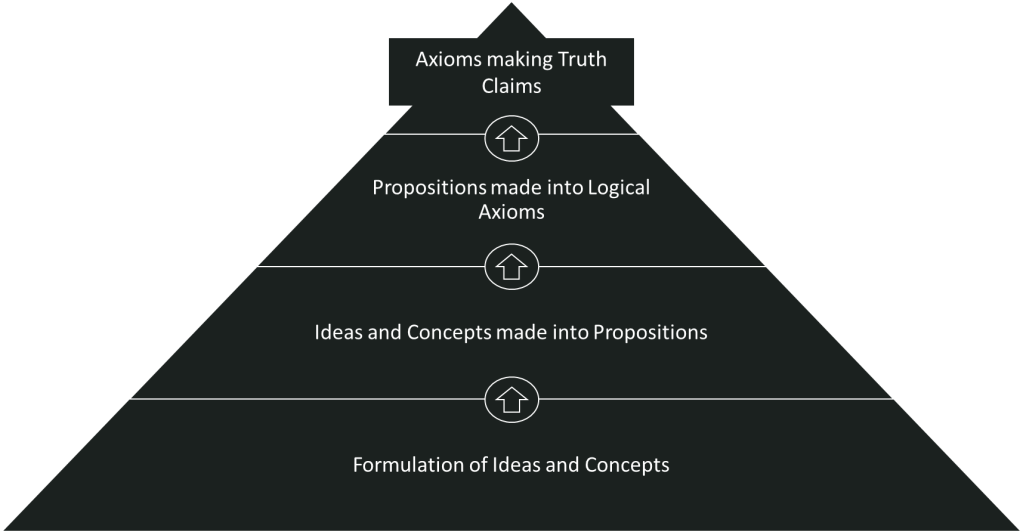
The process of formal logic and propositional logic can be described as an inductive taxonomy, or a framework built upward, toward understanding how analytic epistemology is done. We can start at the bottom with the formulation of ideas, sayings, and concepts into workable propositions to create axioms and eventually truth claims. As shown below, many ideas can be formulated – but must be put through the process of analytic epistemology to be proven as truth in knowledge.
For example, let’s form the idea that dogs are mammals and that mammals are warm-blooded. We can represent “dogs are mammals” as (P), and “mammals are warm-blooded” as (Q) simplifying them into propositions. Axioms explain the connection between the propositions – so dogs are mammals IMPLIES (represented by →) mammals are warm-blooded can be an axiomatic principle, and is shown as such in a truth claim.
| P | Q | (P → Q) |
| F | F | T |
| F | T | T |
| T | F | F |
| T | T | T |
This creates a contingently true statement as it is largely true but incomplete, meaning not all iterations of mammals are dogs for example, that would create a logical fallacy, so we need to reassess. Say we have dogs are dogs (P), mammals are mammals (Q), and warm-blooded is warm-blooded (R). We can say if dogs are warm-blooded, and (∧) mammals are warm-blooded; therefore, dogs are mammals. That becomes a tautological statement or a statement that is true in all iterations.
| P | Q | R | (((P ↔ (R → ⊤)) ∧ (Q ↔ (R → ⊤))) → (P → Q)) |
| F | F | F | T |
| F | F | T | T |
| F | T | F | T |
| F | T | T | T |
| T | F | F | T |
| T | F | T | T |
| T | T | F | T |
| T | T | T | T |
Why is this Important?
I feel this question is self-evident and uncontroversial. The truth is good, and knowing the truth is good. Antithetically, lies are bad, and continual lies compound badness. Therefore, if the objective of analytic epistemology is to find truth compared to untruth; insofar, truth is to find the objective truth and separate from the lies; as in, finding the good by removing the bad – analytic epistemology is considered good. Unfortunately, knowledge today is not this binary of good and bad, it is merged and meshed with many concepts in today’s world. For example, a government lying to its citizens to protect national security could be considered a good lie, or if the truth was released, a bad truth to comprehend; leads to a further question, is there such thing as a good lie or bad truth in this situation? Even in this situation, I would say no.
In knowledge acquisition, finding the answer is finding the truth, and finding the truthful answer is always good, no matter what iteration. Of course, the common thread within education is that truth is subjective – where you get phrases such as “my truth” to enter into the lexicon. There is no such thing as “my truth” only “the truth” which is objective, making knowledge acquisition and learning an objective science. Perhaps one can have a subjective teaching methodology (pedagogy) to obtain truth in knowledge, but the fact remains the end-point is objective.
Too much of our modern view of socio-political topics and culture has become shrouded in the subjectivity of feelings and conceptualizations – as it is sociological outcomes that create our ideas toward knowledge. Ideas are many and all should be welcomed; however, it is the process of analytic epistemology that creates the “debate of ideas” that is much needed in modern discourse.
For more information on analytic epistemology pick up a copy of my new book Pedagogy of the Depressed; alternatively titled, The Foundations and Development of Analytical Epistemology for a Rational Pedagogical Approach – and the Opprobrium of Critical Pedagogy.

 carsonbabich.com
2 thoughts on “Analytic Epistemology: What is It and Why is it Needed?”