
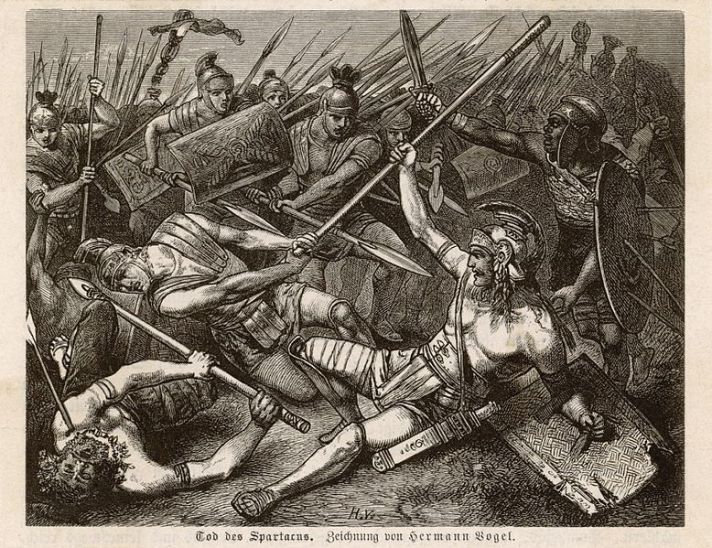
“Spartacus the slave became Spartacus, Emperor of Slaves in an ironic twist of being more Roman than the Romans.”
Mark Corby – Military Historian at University College London
In my recent book, I discussed the massive shortcomings of Critical Pedagogy; notably, how its general ethos claims to be benevolent (i.e., liberating the learner’s mind) through aggressive action (i.e., revolution and toppling of social structures). One thing is for certain, the critical pedagogues in today’s society see themselves as the soldiers of virtue, and the ones attempting to make change for the betterment of society. We see this in many facets such as the cultural landscape of DIES; an acronym accompanying the classic Diversity, Inclusion, and Equity – but adding in the word Sustainability for those United Nations Sustainable Development Goals types; even cheekier, we can call them eco-billionaires. The DIES model and the DIES individual look to bring about aggressive action in changing the world to be more benevolent, have it be changing our art to meet these goals, changing our politics and courts by creating new laws for these goals, or changing society with a forceful vigor to ‘save the planet’ or ‘stop bigotry and violence.’
No one is saying, that on the surface, these are not noble goals because they are. One has to question is your conceptualization true; also, are your methods true? This leads to a theoretical concept I coined called the Spartacus Dilemma which is a situational difficulty regarding the actions of Spartacus, in the way that when the slave becomes master, the power of the master corrupts in a sign of sheer irony over the slaves. Could also be referred to as the Benevolent Dictator Fallacy. We have seen this played out through dictators over time. Hitler thought he was doing good by strengthening Germany – Lenin and Stalin thought they were doing good by distributing the social power from the bourgeoises down to the proletariat. But at the beginning of their reign of terror, no one asked if their conceptualization and methods were true.
The story of Spartacus starts with him being a slave for a Roman Emperor to endure battle and torment from his captors. This leads to the eventual uprising during the night when the slaves stormed the kitchen for weapons and took back power and freedom of their own lives as told by Plutarch. What is not told in Hollywood movies depicting the story is what happens after freedom. Well, Spartacus’s penchant for blood did not end: he pillaged the city of Pompeii; he kept slaves of his own and fought them gladiatorially; at one point, he had the chance to head home in the North leaving the Roman Empire for good, only to choose to travel back South for revenge and riches. Was getting out of bondage his only objective, his concept seemed to not just get out of bondage, but to kill and cause terror for the citizens of the Roman Empire through gruesome methods of torture, rape, forced fighting, and murder.
The Spartacus Dilemma – the actual dilemma – rests on one question: the slave who is not a slave no more and becomes a master, are they still a slave? Did people like Lenin and Stalin still see themselves as revolutionary proletariats fighting the cause for economic liberation while they were starving kulak farmers in the Ukraine? Did Hitler feel he was creating a strong Germany through sacrifice and saving the lives of the German citizens, by committing systematic murder against the Jewish people? Did these dictators see themselves as the revolutionary slave, even though they were the masters of their own evil domains?
We seem to be in the middle of a power vacuum, and I see a lot of dictatorial individuals embrace the mantle of societal benevolence for their own Machiavellian gains. The worry is that this goes completely unnoticed by the populi – relating to Hannah Arendt’s thesis on the banality of evil: an idea that ordinary people commit atrocities, explicitly or implicitly, without awareness, care, or choice. Explicitly in the form of changing national laws to stifle freedom of expression in many nations, or forcing economic hardship through the printing of excess cash, or perhaps even sending funds to a foreign nation while leaving your own citizens to starve. Implicitly in the form of herd mentality such as performing a sense of duty that is not yours to uphold and maintaining a false standard of safety. These all seem like traits of a sick and stagnant society.
If we are connecting the master in this situation to a monster, Friedrich Nietzsche’s famous aphorism works here: “He who fights with monsters should be careful lest he thereby become a monster. And if thou gaze long into the abyss, the abyss will also gaze into thee.” This really has a powerful message about conceptualization and methods. How do we perceive things to be and are our methods just? It also challenges us on how we see control and the consequence of our actions. What can we actually control in the world and what is the consequence of those decisions? I see striking characteristics of the Spartacus Dilemma in the DIES society today. ‘The only way to be happy in the skin you’re in is by mutilating it’. ‘The only way to save the planet is to cleanse the world of its filth (see a Malthusian on what they subconsciously see as filth)’. ‘The only way to stop racism against us is to embrace racism against the other’. My warning is this, be very careful of what revolution you want to embrace as benevolent – as a monster may lurk in its shadowy abyss.

 carsonbabich.com