
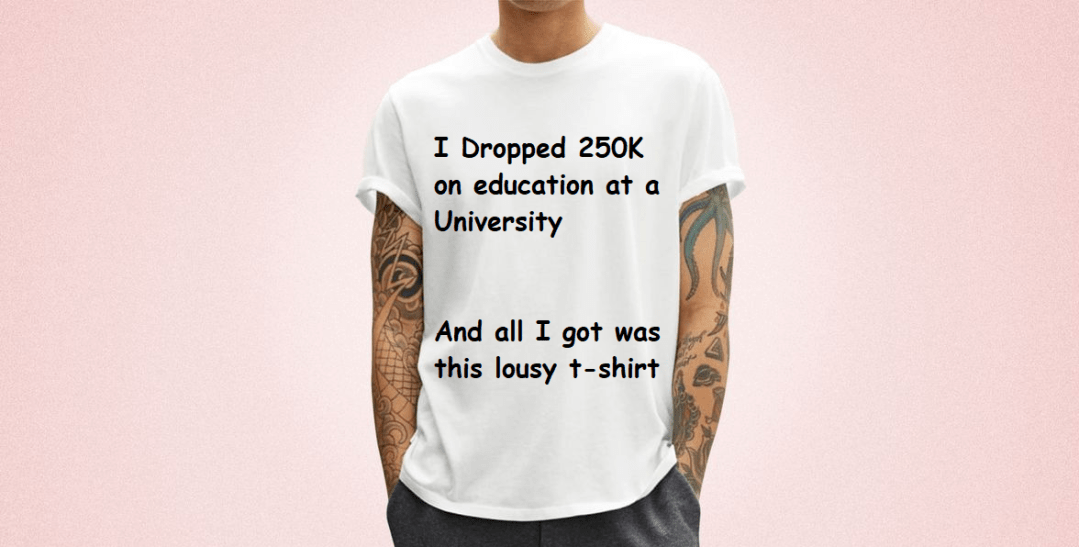
What in the hell is going on inside universities? Why is this question even a thought? Most have looked at universities in the past and had different ideas on what they represented: posh, upscale, bastion of knowledge, academic freedom, or whatever came to mind. One similar thing is that most people left universities alone and trusted that they were doing the right thing in creating the leaders of tomorrow. Now, proposing a question like what the hell is going on inside universities is not a positive question, it signifies a search for an explanation for something that is going wrong. It is reminiscent of the many American mob documentaries I have watched where most of the bosses hated the idea of being in the limelight, rather they wanted to commit their crimes quietly and under the radar of public knowledge. When the mob reached a socio-cultural or socio-political status, top bosses would do anything to quiet the rhetoric so that they could go back to their racketeering, extortion, and prostitution rings in peace.
Perhaps that is the issue, that one can make a connection between the modern-day higher education system and the five families of the New York mafia during the twentieth century. As a parent either looking at schools to send your loved ones to or starting that savings account for their college tuition. I’m sure it would frighten you that the money you saved up going toward university is like giving your money to some goon in a trilby hat, cigar, and long overcoat to be used for ill-gotten gains.
The universities – and to an extent all higher education (community colleges and trade schools) – are front and center on many topics in our social and political climate. Recently, President Joe Biden approved a $10K student debt cancelation for most borrowers that drew praise and criticism from many, some say the debt forgiveness is good but not enough, others say one penny is too much. On top of that, we are in an economic crisis not only with the market, but individuals are leaving professions for new careers leaving certain fields scrambling to find workers – have it be shortages in teachers, cops, firefighters, nurses, and doctors, all are trying to fill gaps.
As a professor in higher education, I want to explore this to see what is going on, I’ve wanted to do a post about this for some time, but I didn’t feel I had enough information, even with my extensive experience studying higher education policy with a focus in educational administration. Perhaps I am still missing some information, but as always, my comments section and email are available for any university administrators to contact me and share their agreements or disagreements with my post. Ultimately, I have narrowed it down to three topics that I plan to write in a 3-part series I feel can explain what is going on in universities, those are a problem in finding a middle ground on student debt, the commodification of the modern university, and the socio-political climate today.
A Middle Ground on Student Debt
This, much like most things in society today, is a very polarizing issue. It has essentially been divided into two camps pro-student debt forgiveness and anti-student debt forgiveness, one side saying 10K is not enough, the other side saying one cent is too much. The anti-student debt forgiveness is upset that individual taxpayers are to shoulder the burden of student loans, while the pro-student debt forgiveness point to the countless bail-outs from Wall Street and other sectors for their f-ups, so why can’t students get relief for what they were promised was a ticket to a good job and a career.
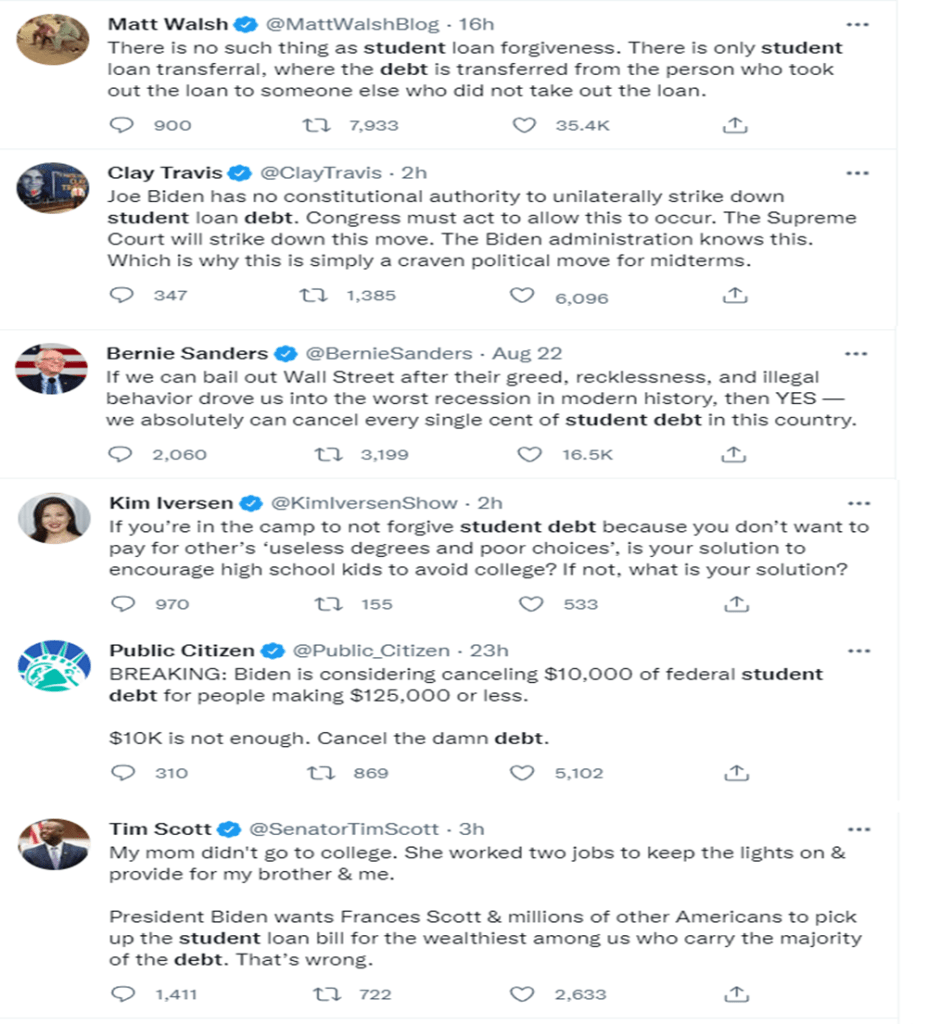
Even as someone who has shown a lean toward right-wing and conservative politics, both have great points on the problem with both sides. It is true, as a taxpayer I don’t want to pay your loan for your mistakes in education choices and the inability to get a job; also, as a former student, it is BS that I have to pay this money when I did the right thing, went to college, got a degree and the job market is not available – like why do I need a bachelors degree to work the line at a car factory? Both have a stake in their claim and if you say they don’t I am inclined to call you a liar because everyone has had this experience at one time or another, even the anti-debt cancellers. In searching for some middle ground ideas, I came across some tweets that I found captured my sense of the situation.
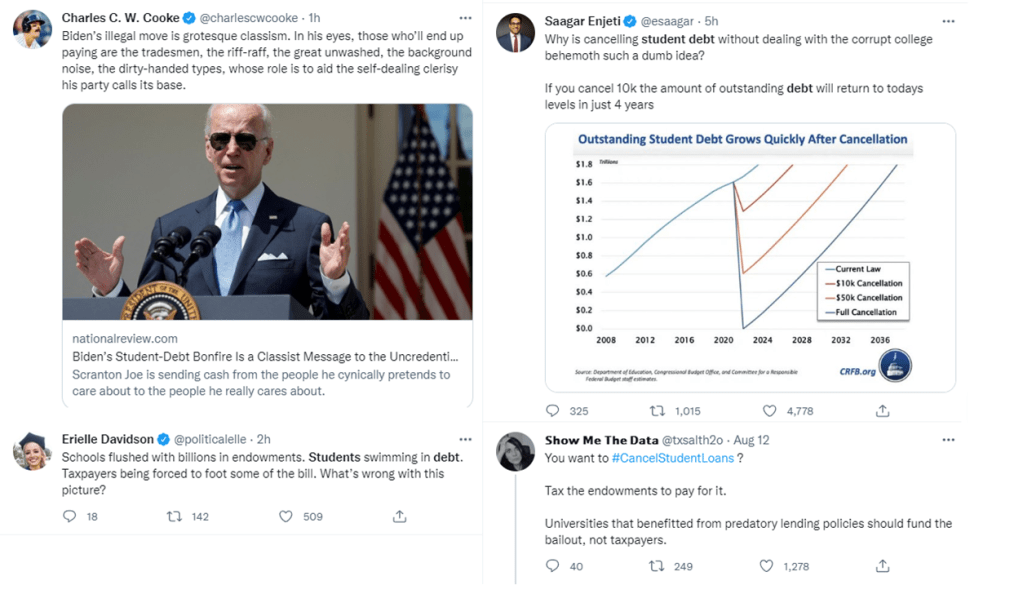
Charles C.W. Cooke writes a great article on how this decision is indeed another cash burden transferred from the wealthy to the middle/lower class which is par for the course for the ghouls in Washington D.C., Cooke writes:
“The colleges, and their endowments, are left unmolested. American culture’s increasingly credentialist presumptions aren’t altered. Within four years, overall debt will return to its present level. With the stroke of a pen, the already-fake deficit savings within the Inflation Reduction Act will be wiped out. This isn’t a reform. It’s not even pretending to be reform. It’s a contemptuous, abusive, unbelievably expensive shot in the dark – the net effect of which will be that fewer people correctly calibrate whether college is worth it, fewer colleges change their offerings to meet market demand, and, because this sort of executive giveaway will now loom large as a possibility, fewer people feel the need to save for college.”
He blends it perfectly with the slippery slope of car loans, and mortgages and I would add one step further, why not forgive debt through harsh addictions like gambling or drugs? As someone who likes his Texas hold’ em, blackjack, and roulette – imagine the burden-free trips I would take to the casino! Is the buffet included in the forgiveness? This is indeed a classist move to help the “best” of our society and remove any responsibility from their hands – a common trope in modern left-wing discourse.
Cooke makes a statement about college endowments, also echoed by Erielle Davidson – Associate Director at the Center for the Middle East and International Law, and @txsalth2o – overall amazing person and should be followed by every person on this planet point out the issue of university endowments. Plus, Saagar Enjeti saying the quiet part out loud and calling the college machine a giant corporate behemoth. So, what is meant by taxing the endowments?
In my post from September 2021 titled University Creation Simulator: Can This Pipe-Dream Become a Reality? I outline the role of the university and what it takes to run one, a key point of that piece is discussing endowments. First, what is an endowment? An endowment is an income possessed or inherited by a university through means of treasuries, investments, tuition charges, and grants. Treasuries mean bonds or T-bills purchased for a price less or equal value to grow and earn additional value. Investments in dedicated assets to appreciate over time (i.e., buildings, land) for the expressed goal of obtaining a return on investment (ROI). Tuition charges are self-explanatory as they are incidental charges for teaching and learning, and grants which are simply taxpayer money through the government toward a specific goal (i.e., research, public investment).
When you hear on the news “X university’s endowment” it is not a static characteristic. It is an amalgamation of many different funds that – in theory – are to go back into the university for services such as obtaining professors, scholarships, and facilities (both academic and leisure). Endowments are the economic machine of the university, so it makes sense to find out the issues with student loans through the economic machine of the university – it is only logical. So, if we look at endowments of a university, preferably public access, we should get a sense of the allocated funds and hope to extrapolate (given varying degrees) to other universities.
Not that I have any animus toward this school, but Michigan State University was the first school that came to mind and a public land-grant university would have the most information on its financials. On page 3 there is a statement from Senior Vice President, Chief Financial Officer, and Treasurer (a lot of titles) Lisa A. Frace outlining financial highlights for the year ending 2021.
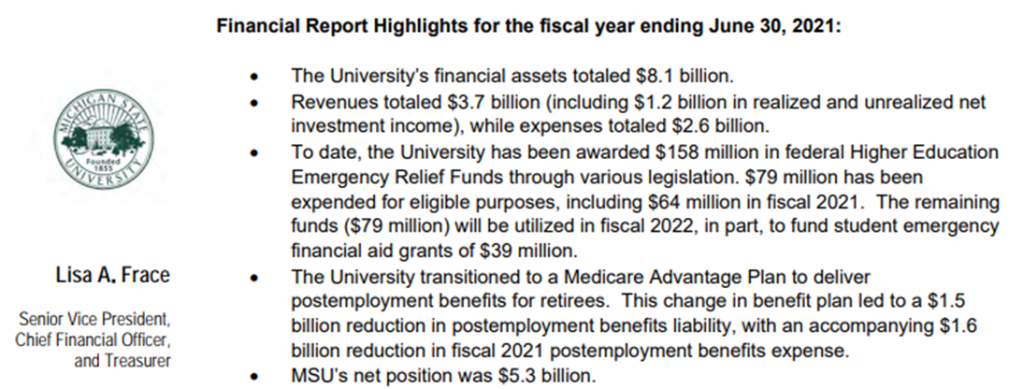
With $8.1B in financial assets and a net revenue of $1.1B and a final net position of $5.3B, assets + liabilities (net position after revenues and expenses) give Sparty a $13.4B net worth after 2021 (addendum: potential in net worth by asset type is 13.4B and uncommon, actual definition of net worth would be 5.3B). That is just through the common university function. Additional comes from donor-funded endowments such as Common Investment Funds (CIF), and donors. Again this is a common misconception that universities use to tie endowment money strictly to donor investment and its benefits. Not the case considering endowments are an intricate web of money to operate the whole of the university. With that said, universities target donors, not because donor endowments are done out of the goodness of someone’s heart for education, but because they are investments to build upon for an individual ROI.
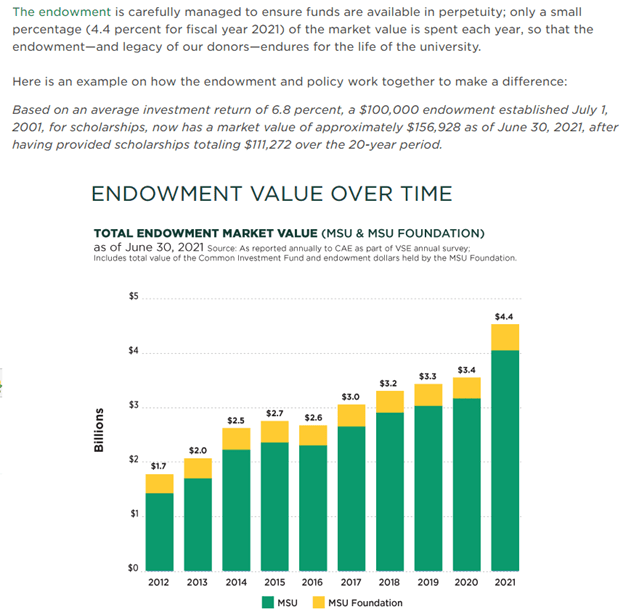
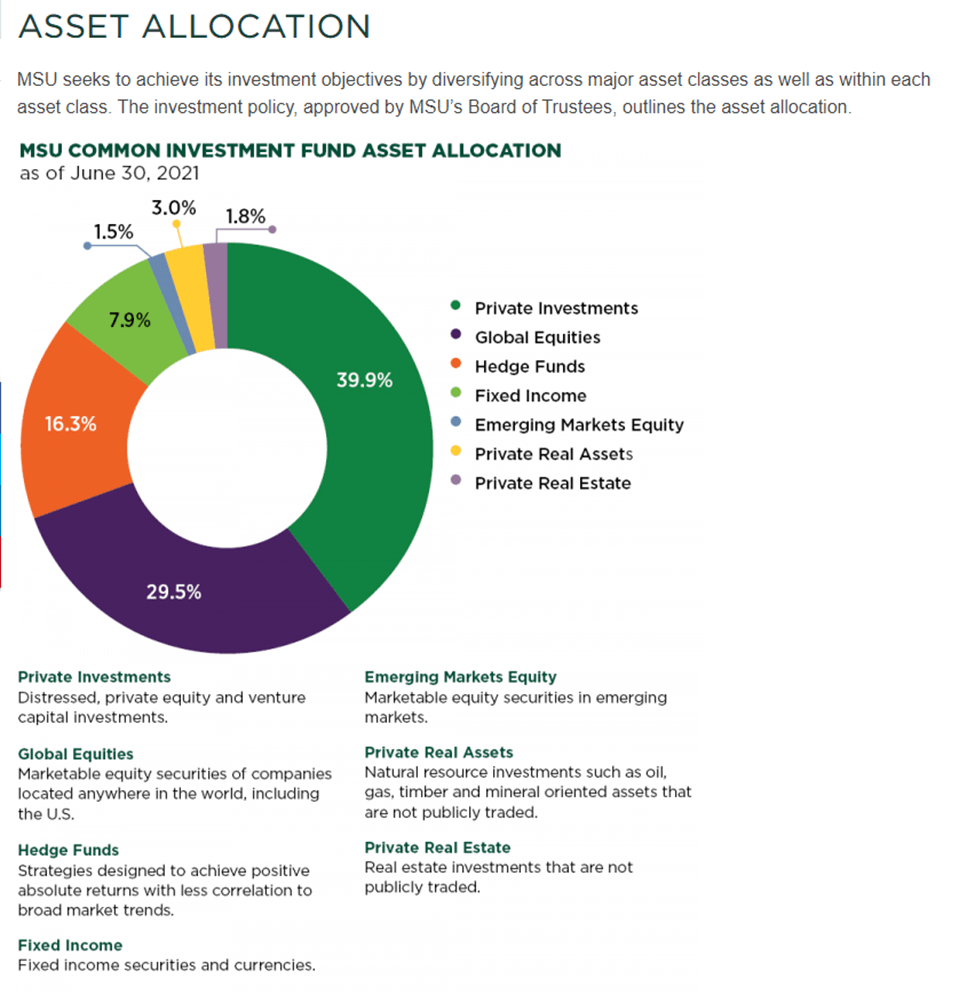
Since this gives us a look into how MSU uses a growth model to increase endowment investment from donors. A savvy business/market mind cannot help but see similarities between the financials of an institute of higher learning and a Fortune 500 company traded on the New York Stock Exchange. Keeping that in mind we see the net revenue breakdown on page 5 of the report, and grant revenue on page 10 outlining the who and where the money came from.
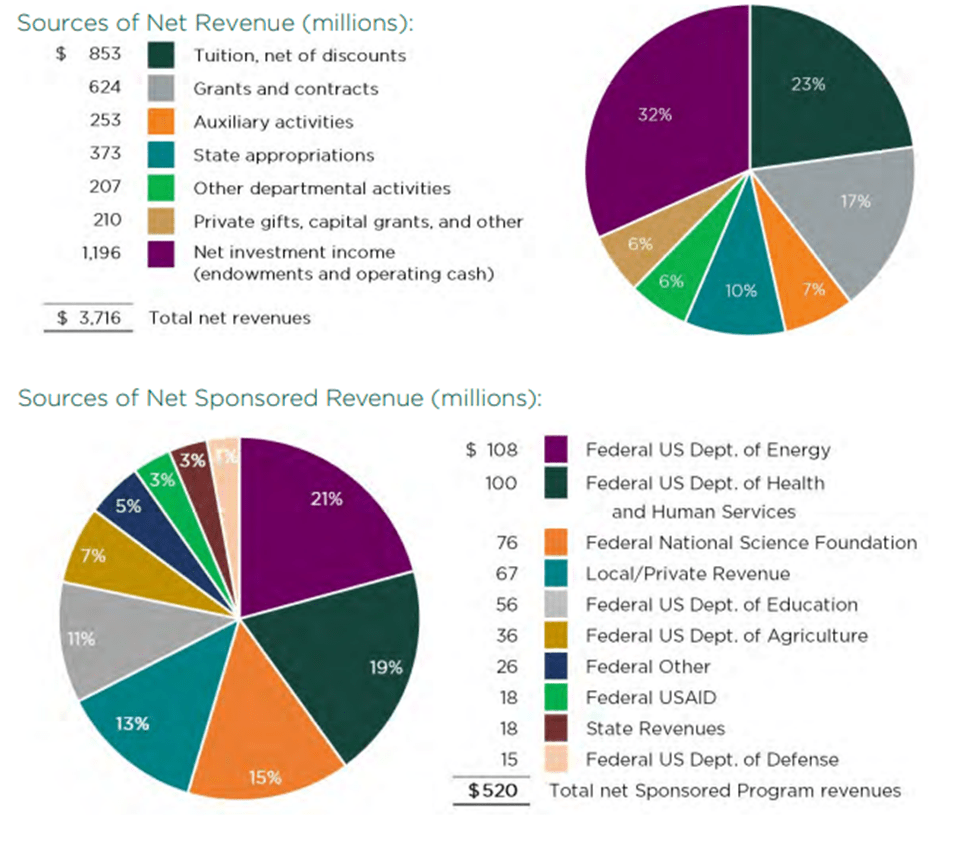
One striking thing is out of that 3.7B dollars of net revenue on graph 1, 55% or 2.03B came from investments and tuition costs, notably ¼ of all revenue for Michigan State University comes from tuition. What can we conclude here is that a lot of the money comes from assets, investments, tuition, and grants (as seen in graph 2). I am still for taxing endowments, but where do we start, and if we do tax endowments for the sake of the students, how do we ensure that the students (a key stakeholder in the university’s financial operation) are not burdened?
Most financial statements put the positive stuff at the beginning, the real digging starts when you try to find what this revenue is being spent on.
It is so interesting reading financial reports like this because not only is there a technical logos element, but there is also a passionate pathos element as well. Financial statements paired with sharp professional images of the campus, smiling students, and a color scheme that screams Spartan pride – look even the little coronavirus has Spartan spirit on page 5.

Absurdities aside, let’s get into the nitty-gritty. Page 30 has a breakdown of the revenues compared to expenses. Some items that stand out are that tuition was the main operating revenue and the highest expense went to professors and research projects. You can decide if that is fair, but it seems like the basic model, you pay for an education, and I get paid to teach you and advance society through research. One item of interest is the apparent negative expense (meaning a positive) for post-employment benefits lowering overall benefits to make up lost operating income to covid this essentially led to MSU doubling their net position YoY 2020-2021. The real interesting stuff is the cash flow summary on pages 32 and 33.
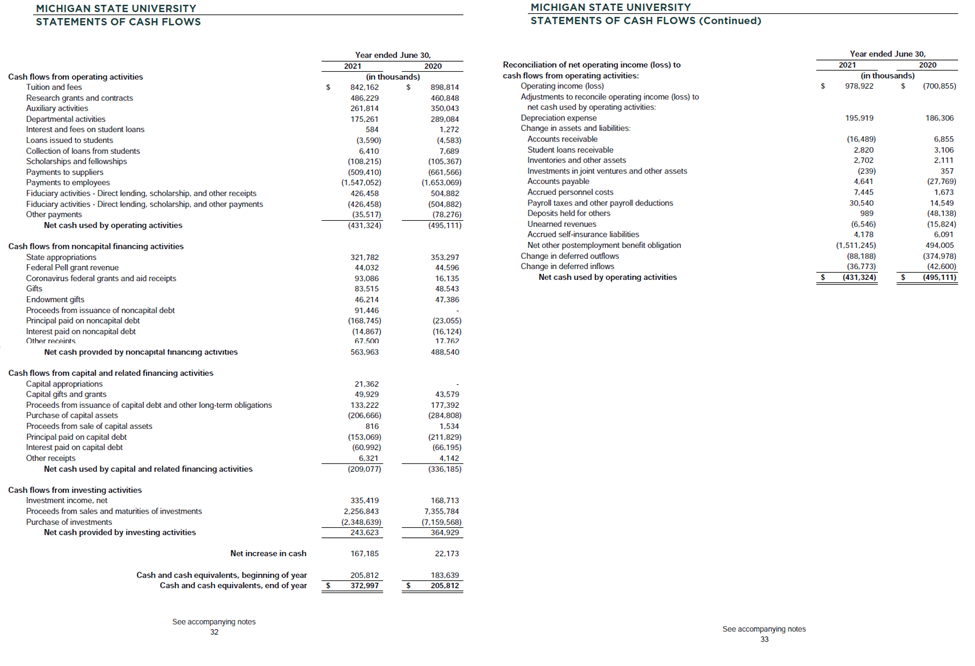
With $842M coming in through tuition, $2B went out to employee payments (teaching and administration) and supplier payments (food, housing, maintenance, legal aid, employee training, auditing services, communication services, copyrights, and much more). The schism is very pronounced and can vary depending on your feelings about finance. For myself, this problem with student debt and universities is a reliance on a growth model for investors with substantial expenses going toward teaching, administration, and suppliers. Furthermore, close to $400M is going toward paying off debt and interest and $206M toward purchasing capital assets (sports complexes, buildings, land for a golf course, art, event space, etc.). One might think this should be paid for through gifts and endowments; however, that is not the case considering cash flow only represent $129M.
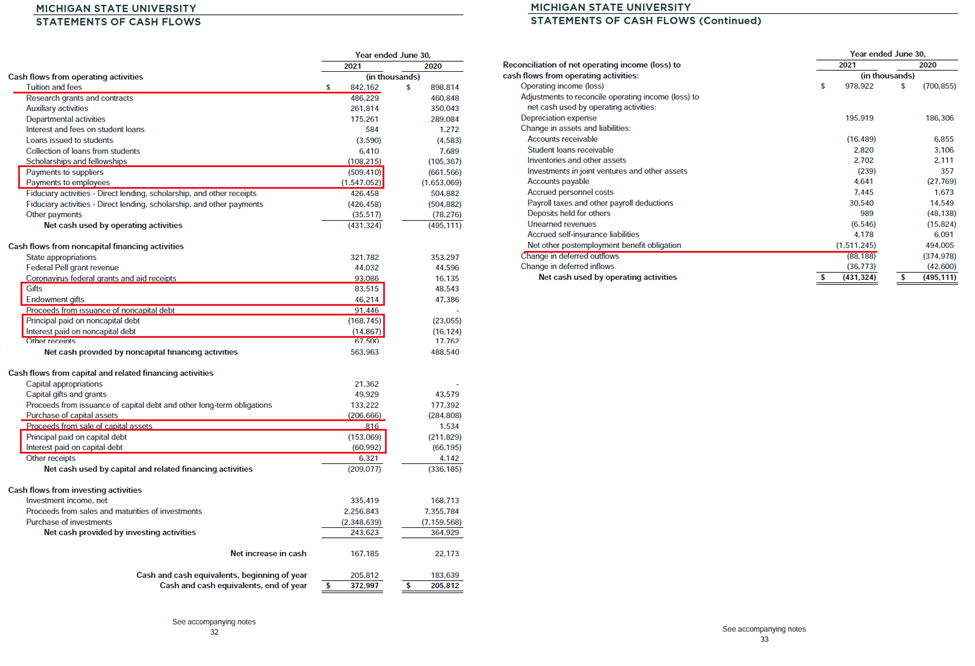
The ratio of tuition dollar to employee/supplier dollar at Michigan State is 1 dollar to every 2.4 dollars, meaning for every dollar spent by the student, over double is being spent on teaching/administration salaries, and suppliers. For every dollar of a gift and endowment, 3.9 dollars are going toward the purchase of capital assets, and principles paid on debt and interest. It is investments that save the day and the appreciation of T-Bills and Bonds that brought in over $2B which was immediately reinvested. Other glaring items show over $1.5B going toward post-employment benefit obligations such as retirement and pension.
Implications
Reviewing the financials, one should take a middle-of-the-road approach with student loans and understand both sides of the issue. The main thing is that you should not make villains out of students, the middle class, or even the actual professors teaching the courses. One must take a critical look at the cash flow and expenses of a university. For example, if you see a brand-new clubhouse at your university’s golf course, ask the question could this capital asset have been used better elsewhere, possibly toward the lowering of tuition? If you see a university go on a massive hiring binge for more administrators and unnecessary services, you should ask where can that money be better suited to go.
The student debt issue is a challenging problem that we need to address, and something that universities need to address as well, they won’t as long as they can be saved through their investments through CIFs managed by the board of trustees. Much like the Wall Street companies, the money is centralized at the top and everyone below is left to pay more. It would seem that canceling student debt would be a disaster yet forcing students to make up for the mismanagement of universities would be a disaster also. Perhaps it will come down to legislative auditing of universities and how their funds are invested and allocated along with the potential of an endowment tax.
Topics from this part will carry over into part 2 where I will discuss the commodification of higher education and question are the students, students? Or are they customers?

 carsonbabich.com
One thought on “What is Going on in Universities? Student Debt, Commodification, and the Socio-political Landscape. Part I: A Middle Ground With Student Debt”