

It is 2021 and a conference is underway in the idyllic mountain town of Aspen, Colorado. The Aspen Ideas Festival is a who’s who of business leaders, policymakers, researchers, and journalists that “gather for stimulating, and sometimes provocative, conversations about big ideas and bold approaches to better health for all” – according to the Festival’s Event Overview. One of the panels has sportswriter Jamele Hill talk with author, professor, and social influencer Ibram X. Kendi on ‘How to be an anti-racist?’ The crowd seems to have a mixture of different races, but what ties them together is their affluent class considering the Festival charges nothing below $2,500 for basic access and $15,000 for Patron access. The Hill and Kendi panel was an interview followed by a Q&A portion after. At this time we have reached the Q&A section and Jamele proceeds to pick the next person to ask a question and this ensues:
Kendi defines racism here as “a collection of racist policies that lead to racial inequity that are substantiated by racist ideas.” This was followed by a confusing silence, one member of the crowd looking to her left and right in a sense of ‘am I the only one confused’, only to be followed by laughter to reassure her that everyone was equally confused. The person who asked the question then asks Kendi to repeat the question, only for Kendi to repeat “a collection of racist policies that lead to racial inequities that are substantiated by racist ideas” – Kendi further explains anti-racism through a mirrored response as “a collection of anti-racist policies leading to…racial equity that are substantiated by anti-racist ideas”. In between that response, Kendi attempts to guide the audience like a kindergarten class through the definition one more time. After that the crowd is silent and Kendi looks visibly uncomfortable, along with the audience, proceeds to the next question.
Anti-Racism: A collection of anti-racist policies leading to…racial equity that are substantiated by anti-racist ideas
Ibram X. Kendi, Aspen Ideas Festival
Simple linguistic rules would say that Kendi did not define anti-racism or racism, rather, used anti-racism in a sentence to describe its occurrence relating to policy. If anything, anti-racism in this sense is a verb before the nouns of policy, equity, and ideas. If anyone tunes in to the Scripts Howard Spelling Bee Final, Kendi did not define racism, merely just put it in a sentence for more context as shown in this event. Ok, maybe he was nervous, maybe he was caught off guard with that question. Let’s try a more prepared statement, in promoting his book How to be an Antiracist:
Ok, some glaring items here, linguistically, and logically he suggests that we should not strive to be ‘not racist’ followed by a clear definition of ‘not racist’ as his term anti-racist: “When someone says there is nothing wrong with any racial groups, they’re being anti-racist”. Further to explain identities or tattoos (a term I am not familiar with when describing definitions) and that they are not static but dynamic depending on the situation. Again, anti-racism becomes a verb to describe an action or occurrence relating to situational or chronological instances. ‘Someone is more anti-racist in June as opposed to December’.
This still does not provide a clear definition of what is anti-racism, so I go to Kendi’s book to find the definition. He is the founder of this term, so it should not be this difficult to get a clear and concise definition. In the New York Times Best Seller How to be an Antiracist, Ibram X. Kendi defines anti-racism as:
“One who is supporting an anti-racist policy through their actions or expressing an antiracist idea”.
Ibram X. Kendi, pg. 13
Once again, anti-racism is a verb describing an action or occurrence of policy, situation, or idea. As a caveat, this is not to say the word ‘racist’ or ‘not racist’ could ever be used in the form of a verb to describe either ‘a racist person’ or ‘not a racist person’. But Merriam-Webster describes racism as either an adjective or a noun:
- Adj: having, reflecting, or fostering the belief that race is a fundamental determinant of human traits and capacities and that racial differences produce an inherent superiority of a particular race.
- N: someone who holds the belief that race is a fundamental determinant of human traits and capacities and that racial differences produce an inherent superiority of a particular race.
Encyclopedia Britannica defines racism as:
“Racism, also called racialism, is the belief that humans may be divided into separate and exclusive biological entities called “races”; that there is a causal link between inherited physical traits and traits of personality, intellect, morality, and other cultural and behavioral features; and that some races are innately superior to others.
In these clearer definitions, racism is a definitive idea that someone has or describes as inherited traits of racial superiority influencing physical, behavioral, intellectual, moralistic, and cultural determinants. What we see as fundamental differences between the definitions of racism and anti-racism – almost in the form that anti-racism does not even relate in any coherent way to racism. By saying not-racism does not exist or is a term of denial is to reject the original definition of racism, as not racism would be diametrical definitions (i.e. not racism is not someone who holds the belief that race is a fundamental determinant of human traits and capacities and that racial differences produce an inherent superiority of a particular race).
Is it Illogical?
Running anti-racism through a test of if it’s illogical or not, we attempt to use formal logic to describe anti-racism, and to an extent, racism through propositions, logical connectives, and axioms. To start we will take the definitions of racism and put them into categories of actions and ideas to merge with anti-racism, and delineate the two:
| Racist Actions (P) | Racist Ideas (Q) |
| Physical traits | Belief of division |
| Intellectual traits | Inherent superiority |
| Moral traits | Fundamental determinants |
| Cultural traits | Exclusive entities |
| Behavioral traits | The capacity for racial difference |
Now that we have a delineation of the actions and ideas, a quick tutorial of basic connectives that will be used in the form of logical symbols:
- → : Material implication/conditional implication (if, then)
- ↔ : Material equivalence/biconditional implication (if and only if, the same as, equally)
- ¬ : Negation (not)
- ∧ : Logical conjunction (and)
- ∨ : Logical disjunction (or)
- ⊤ : Tautology (truth, full clause)
- ⊥ : Contradiction (false, empty clause)
To run a logical test, we need to have propositions to create the axioms. For the sake of this exercise, R will be represented as racist or racism; and, as above, P will be racist actions, and Q will be racist ideas. What we do now is run axioms through a truth table to see if the statements come out as a tautology: true in every possible interpretation, contradiction: a logical incompatibility between two or more statements or propositions, or contingency: neither necessarily true nor necessarily false.
If we have the statement “racism implies racist actions if racism is biconditionally true and racist ideas if racism is biconditionally true” we get an axiom that looks like this:
(R → (((P → R) ↔ ⊤) ∧ ((Q → R) ↔ ⊤)))
On the other hand, if we have the statement “not racism implies not racist actions if not racism is biconditionally true and racist ideas if not racism is biconditionally true” we get an axiom that looks like this:
(¬R → (((¬P → ¬R) ↔ ⊤) ∧ ((¬Q → ¬R) ↔ ⊤)))
What we see here is the axiomatic definition of either racism or not racism – either racism implies that racial actions and ideas implicate racism to be true or not racism implies that not racial actions and ideas implicate not racism to be true. If we run these through a truth table, you will see these are both tautological statements.


Say we add in S as anti-racist, and if according to Kendi anti-racism is not ‘not racism’, it is something different. Let’s say we suggest “not racism implies not racism or anti-racism implies not racism”
((¬R → ¬R) ∨ (S → ¬R))
That itself is a tautological statement because we have not defined what racism is, so Kendi in his sense sees this as true. However, Kendi has stated not racism and anti-racism are two different concepts and ideas. So, let’s create an axiom that represents this “not racism is the same as not racism and anti-racism is the same as anti-racism implies anti-racism is the same as not racism” as per Kendi’s assertion.
(((¬R ↔ ¬R) ∧ (S ↔ S)) → (S ↔ ¬R))

What we see here is that this statement is contingent on its propositions. We know that not racism and anti-racism can be true as they are both propositions in the world. However, the important lines are lines one and four. Whether not racism or anti-racism are true or false, similar concepts or different concepts according to Kendi, both are contradictory statements.
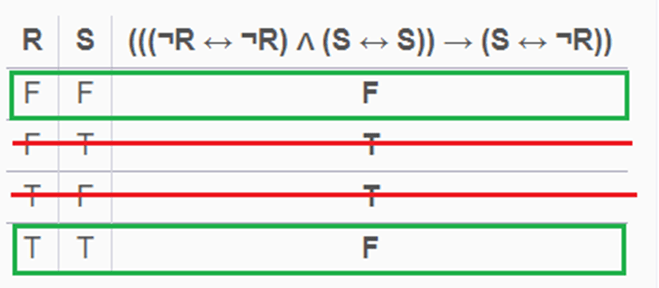
What this tells us now, definitively, is that ((S ↔ ¬R) → ⊥) or it can be written out as ((((¬R ↔ ¬R) ∧ (S ↔ S)) → ((S ↔ ¬R) → S)) is false. We can apply this to the propositions of P and Q (racist actions and racist ideas) for further investigation.
((((¬R ↔ ¬R) ∧ (S ↔ S)) → ((S ↔ ¬R) → S)) ↔ ((((¬R → (¬P → ¬R)) ↔ ¬R) ∧ ((¬R → (¬Q → ¬R)) ↔ ¬R)) ↔ (((S → (¬P → ¬R)) ↔ S) ∧ ((S → (¬Q → ¬R)) ↔ S))))
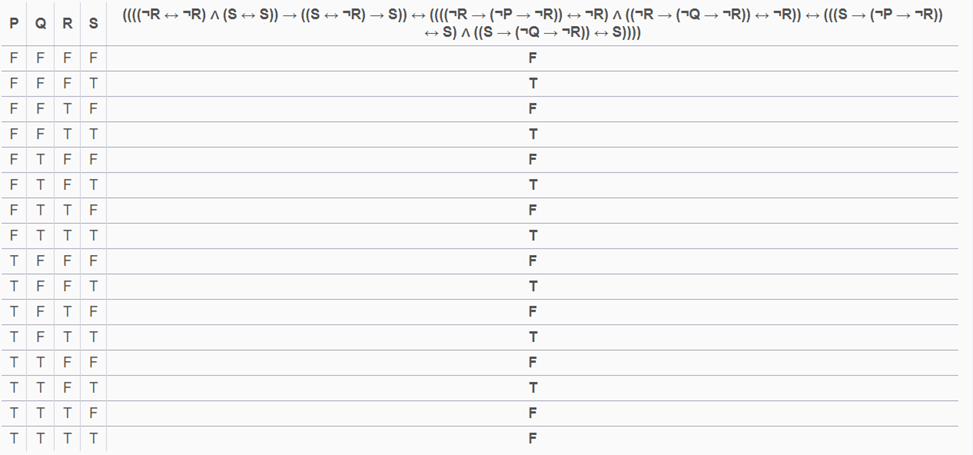

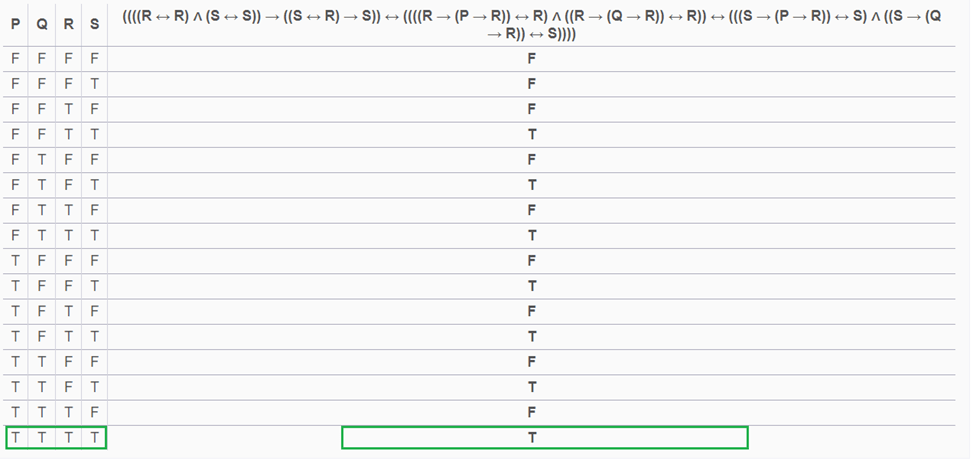
This axiom is contingent on the propositions provided, but it is largely a contradictory statement as top and bottom rows render a contradiction, and relation to propositions P and Q are largely contradictory. Interestingly, when taking negation out of the formula it is largely a contradictory statement considering the logical operators do not consider the rhetorical nuance. However, when the propositions of racism, racist actions, racist ideas, and anti-racism are true – it yields a true result. Now, this is not to confirm that the concept of anti-racism is indeed racist according to the formal logic, considering logic is just coding with the individual entering the code. However, with further investigation into the linguistic properties of anti-racism and if we confirm that anti-racism does not imply not racism, logic would deduce that anti-racism implies racism.
***
In summation, when using the formal logic of propositions to create axiomatic truths, we find that the concepts of anti-racism relating to the fundamental concepts of racism and not-racism are illogical based on the coding through propositions and logical connectives. As a disclaimer, propositional logic is not a perfect measure, but it is a quantitative measure nonetheless that removes the obscurity that the concepts of anti-racism, CRT, or any other critical theory generate and find a logical understanding. Furthermore, it is necessary to challenge these notions given the logical inconsistencies found with confidence.
Fortuna audaces iuvat

 carsonbabich.com