
Recent news by the Wall Street Journal shows how CEOs are being more careful, questioning their role in social issues after the turbulent news involving Disney with Florida Governor Ron DeSantis. In the end, it is returning to the old axiom of caring more about the shareholder rather than the stakeholder, which is not that old of an axiom, as it was only introduced into the corporate landscape during the 1980s. Twitter is another example of this as shareholders won out in the end over Elon Musk’s $44 Billion acquisition of the company much to the chagrin of modern elites who maintain the stakeholder model.
Simply, this is the main question that CEOs must ask themselves. Who is more important, the shareholder or the stakeholder?
In an article I wrote back in December of 2021, I outlined the origins and explanations of doomed ESG investing (read: The Web That Binds Us: Origins, Explanation, and the Psychology of Doomed ESG Investing). I warned of the potential Enron-Esque characteristics ESG has – from a new iteration of mark-to-market strategies to generally weak investments with poor return on investment (ROI) and underperforming exchange-traded funds (ETF) metrics. What ESG ultimately tells us, is that it rather put the stakeholder ahead of the shareholder in meeting triple-bottom-line practices of the planet (environmental), people (social), and profit (governance). With that said, I feel it is important to provide definitions of what a shareholder is and what a stakeholder is considering people who might not be familiar with the topic could associate the two words as meaning the same thing, which they are not.
- Shareholder: an individual or legal entity that is registered by the corporation as the legal owner of shares of the share capital of a public or private corporation.
- Stakeholder: is a party with an interest in an enterprise; stakeholders in a corporation include investors, employees, customers, and suppliers.
Looking at both definitions, it is understandable that a CEO can have a tough time balancing the needs of both shareholders and stakeholders. However, in recent years – because of ESG – the term of a stakeholder has expanded beyond the definition of investors, employees, customers, and suppliers; it could mean potential investors, employees, customers, and suppliers. Therefore, creating the situation of someone with no legal or financial ‘share responsibility’ in your company having a say in how a company operates. This ultimately suggests that ESG funding is based on a dubious – at most: questionable – assumption of potential investment that is not proven.
Of what use would my statement be without data supporting it? First let’s take a look at Disney which has lost legislative battles, notably its tax exemption through the Reedy Creek Improvement District which provides special exemptions for Disney to essentially operate as a township with its governance. Now legal squabbles aside, this spells trouble for Disney’s tax exemption in the area. Furthermore, statistical implications of this show that heightened taxes provided by Walt Disney World, would make prices go even higher for services, something that can be untenable for Disney as their already inflated prices could be too much of a burden for travelers.
Now, is this decision good for the shareholders or the stakeholders? One can make arguments for both sides as it would prevent Disney from getting to weigh into social issues and focusing on providing an experience to people, in return, growing the share price for investors. Another angle, with heightened prices this will drive away current customers and potential customers which gives ammo to pro-ESG advocates suggesting detrimental outcomes when no one comes to the park. The reality is, they are not coming to the park because of non-ESG outcomes, they are not coming to the park out of basic shareholder outcomes of ROI and seeing no economic benefit of going to the park. Thus, by incorporating customers as quasi-shareholders (solely focusing on investment returns of time and money at the park), Disney can remain extremely viable and profitable, even without this tax exemption. Regardless, the way it is working now is not good for shareholders at this current time – essentially an outgrowth of inflated prices and too much political involvement.

Twitter on the other hand has been confirmed as the de-facto town square and its situation is more simplistic. Certain voices are being shut out on the platform, Elon Musk does not like it, and he is doing something about it. He has vowed to return free speech (as outlined in the American Constitution) to the platform and remove the big-tech censorship that has plagued these platforms. The political and emotional charge about Twitter is a discussion all its own, but is this move better for shareholders or stakeholders? Shareholders obviously, considering its stock rose dramatically after the acquisition, meaning the shareholders won out, but what does that mean for the stakeholders?
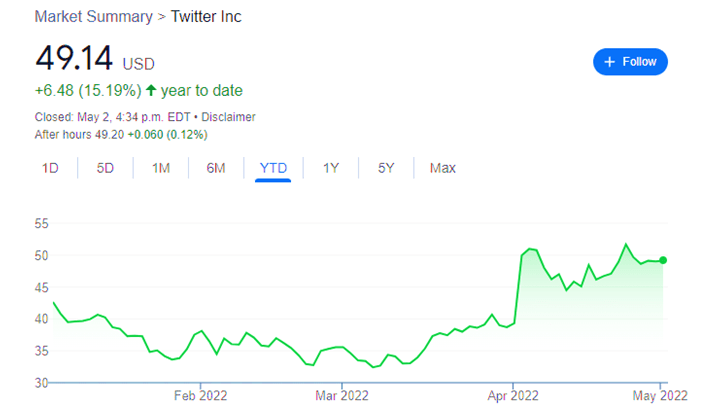
I think what this shows to stakeholders is that if you decide to engage in the free market, you have to accept the free market, and by accepting the free market is accepting the objective metrics that are found in the free market such as shareholder price and ROI. Perhaps it is a reflection of the greenwashing rhetoric and the social justice economics are not resonating with people who have a financial and legal share in companies and who want to see profits rise. After all, it is the shareholders who rely on companies doing well which see their 401Ks and pensions rise due to good ROI performance. Ironically enough, it is shareholder investment that has more emotional attachment than stakeholder investment as company performance impacts college funds, retirement funds, and general investments such as home mortgage. Although the current recession is causing pain at the moment, it is shining a light on the failure of ESG as it reflects negative outcomes in understanding what drives the populous: gas for vehicles, food, and general day-to-day economic life – all causal from shareholder ROI.
In the end, people want their alcoholic beverage company to sell a product that renders desired outcomes (yes, one of those is intoxication), they do not want to be preached about transgender issues. People want their banks to hold on, protect, and reinvest their money safely, they do not want to hear about pelicans in the Gulf of Mexico. People tune into sports to escape from the troubling reality of the socio-economic world, not to be reminded of it during a pre-game show. It is hard to tell if ESG will continue out of sheer ignorance, but I do think people are realizing its failure, notably CEOs, to go back to the method of making shareholder profits rise, as we are seeing how much its benefits are exemplified. Thus, the truism stands: shareholders > stakeholders.

 carsonbabich.com
One thought on “Shareholders > Stakeholders: Could Disney and Twitter Reflect the Beginning of the End for the Narrative around ESG?”