

One of the only bipartisan actions to take place in 2021 was Republicans and Democrats coming together to sign the Uyghur Forced Labor Prevention Act that ensure goods made with slave labor in the Xinjiang Region of China do not enter the United States market or for other purposes. This is a fantastic first step in addressing the continual threat of China – not only in the US – but the world. Some highlights of the bill are as follows:
“In the Xinjiang Uyghur Autonomous Region of China, the Government of the People’s Republic of China has, since 2017, arbitrarily detained as many as 1.8 million Uyghurs, Kazakhs, Kyrgyz, and members of other Muslim minority groups in a system of extrajudicial mass internment camps, in addition to arbitrarily detaining many in formal prisons and detention centers, and has subjected detainees to forced labor, torture, political indoctrination, and other severe human rights abuses.”
Some of the ‘other severe human right abuses’ are in section 3 of the bill outlining the “widespread or systematic attack directed against any civilian population” including “murder, torture, extermination, enslavement, rape, sexual slavery, or any other form of sexual violence of comparable severity”. This is in addition to reports of “forced sterilisation” of Uyghur women while within the camps. Also, introduces more pressure on businesses who have engaged with Uyghur labor such as American multi-national corporations Nike, BMW, and Cisco Systems who were involved in the use of forced labor for their products. More maliciously, we have companies like Microsoft, Apple, Amazon, and Google who have engaged in the forced labor through offering the Chinese surveillance of the region.
This is a major first step in a long process that takes makes our current cold conflict with China turn hot, but it could be more of a smoke screen from an administration looking to score points in a failing presidency. With bipartisan support, we have bipartisan disdain as the corporatists are upset considering this is the first blow to a 50-year feast on China as a tool for multi-national monetization. Pro-communist voices in the west are upset at this procedure, seemingly siding with the neoliberal cosmopolites they claim to revolt against, modern communists are predictably hypocritical. However, this has been a pattern of behavior of the Chinese, and has been present for decades now on the global stage. This seems to have come full force since the COVID pandemic from their country, and now is a time that we need to address the ‘China problem’ that has been staring us in the face for the greater part of the twentieth century.
First, it may come as a surprise to think the United States in 2021 is not the same as the United States in 1991. In 2021, the US is no longer a hyper-power as in total economic, social, and military dominance. The rapid growth of China has relegated the US to a once again super-power, sharing the stage with another communist nation. The influence of China cannot be understated as this was a plan by the Chinese Communist Party (CCP) almost 50 years in the making. Ever since its entrance in the UN in 1971, China has been building its global influence decade after decade in the shadows of the Cold War between the United States and the Soviet Union. After the collapse of the Soviet Union and the rise of the globalized state, China was garnering influence with intergovernmental organizations through strategic funding and membership involvement. It was when China joined the World Trade Organization in 2001 where their influence on corporations took a giant step. Although the goal was to change China’s economic structure, China instead took advantage though American investment and the all-to-sweet fruit of globalization that American companies enjoy. Supply chains and cheap labor that puts our most significant commerce and culture in their hands.
That 50 years of growth after their 1971 summit is not the complete story when it comes to China. Many war and political experts have said, in some form or another, that China is not a short-term operator – they always play the long game. Arguably this game could have started in 1971; however, the story started even earlier with the Proclamation of the Peoples Party of China in 1949. After years of civil strife with the Republic of China (modern day Taiwan), CCP Chairman Mao Zedong sought a new collectivized mission for the people of China and growth of a prosperous nation. Of course, this ‘growth’ was not virtuous given the hostility of the Chinese as a proxy in the Korean War and the subversive propaganda coming home to roost when equality, eradication of poverty, and a country for the people was not realized from 1950-1960.
In this time a new form of artificial aristocracy blossomed in the CCP as more party members began exploiting the Chinese people – especially the farm laborers – for grain and rationing food. Distrust began to grow in the party and in 1957 with Mao – after hearing about the criticism he sought out for in the Hundred Flowers Campaign – turned on his people through subversive media calling them ‘rightists’ and enemies of the state including the hypocritical crime of supporting the flower campaign he created. 1958 saw yet another conflict with Taiwan with a retreat from the CCP in a failed attempt to liberate. Taiwan – with help from the United States – was formidable compared to China and this was perhaps the start of Mao’s campaign to become a super-power. Of course, he had to show his might to the people of China to reflect that any rightist would not be welcome under his banner.
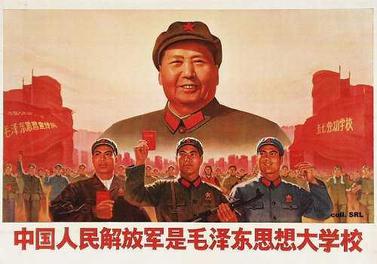
In 1966, the Great Proletarian Revolution took place and Mao’s cult of personality grew. This on the backs of 30 million dead from the Great Chinese Famine from 1959-1961 which saw peasants eat clay to survive and witness the dead being eaten by rats. The horror continued in 1966 when Mao’s revisionist twist saw the Red Guards – a collection of radical communist students – hunt down teachers, principles, and intellectuals, going as far as beheading people and killing infants by throwing them to the ground and cutting them in half during the systematic massacre event called Red August.
This would continue till 1976 due to Mao’s continuing narcissistic psychosis of traitorous action from the people and party members. Even during the 1971 entrance into the UN, one might want to ask, why would nations compliment this regime with trade, if they knew about the atrocities? Naivete from the Americans who thought they could change this regime, and other nations with globalist cosmopolites at the helm had visions of exploitation of China’s land and access to massive population were too strong of motivators, and were blindfolds to the atrocities committed. What this history lesson tells us is that the CCP was built on evil despotism, but their influence was given breath through naïve acceptance through supposed liberalized nations.
This sets the course for China’s plan of soft power and working the infiltration of our economic system through Wall Street investment, our social system mainly through Hollywood and entertainment, and our political system considering the scourge of crony capitalism that puts our elected leaders in the interest of corporations. In turn, their interest are what China desires. I am constantly reminded of Kennan’s Long Telegram in which he warns us of the sphere of influence caused by the Soviet Union after World War II. This, on the other hand, would not be a warning as it is clear to what is happening, and our leaders are willing to allow it with no push-back acting like greedy nomads with zero patriotic ethics. As mentioned, the economics of the Uyghur detainment were felt all the way in Washington D.C. when – in November 2020 – lobbying against the Uyghur Forced Labor Prevention Act took place from the multi-national companies benefiting off of slave labor.
This came to a head in 2020/2021 in a long line of rebukes, challenges, threats, and powerplays from the CCP in the recent months, fresh off a 100-year celebration of the communist party’s founding. China reflected a stronger stance of authoritarianism much more than in recent years, here is a list of current controversies involving China, just in the past two years alone:
- Building tensions towards Taiwan and Australia.
- Subversion and coverup of Uyghur genocide in Xinjiang province.
- Chinese rejection of any investigation into the COVID-19 lab leak and all but threatened the United States not to pursue. Even after an August 2nd report all but confirmed the lab-leak from the Wuhan Institute of Virology (WIV).
- Harvard professor Charles Lieber convicted for lying about money received for American biochemical research being sent to the CCP.
What are the implications of this? Well China will surely not be happy, given this act hinders their economic prowess which is already suffering due to their own version of a market failure from the 1 trillion credit meltdown through a housing debt crisis. On top of that, their chickens coming home to roost with calls to #BoycottBeijing2022 gaining traction that can hurt the interests of the CCP further ahead of the Winter Olympic games.
But if history tells us a lesson, the naivete and benevolence toward China will only allow the regime to continue the atrocities that have been going on a lot longer than we have known. Even with the information out and the historical precedent, NBC, for example, is all geared up for their coverage of the Olympic games in Beijing. NBC, another nomadic neoliberal power corp. that does not want to upset the apple cart when it comes to China’s influence and resources for financial capital. I think these companies will be in a rude awakening of what’s to come, or they will be complicit in future violent political conflict. In that case, we’d better watch out.
In recent months we have seen China cozy up to other authoritarian regimes such as the Taliban in Afghanistan, Iran, and Saudi Arabia. This is setting a stage of military belligerents looking to be NATO v. Authoritarian regimes – Russia being a wildcard. One must wait to see how the market reflects this bill passage and the outcome of the Beijing Winter Olympics to get a sense of how this tension will continue. Because if history has taught us anything, there is nothing like a good war to stimulate the economy.
One cannot help but refer to Thucydides Trap when discussing the potential of a Sino-American war. Coined by Graham T. Ellison to describe an apparent tendency towards war when an emerging power threatens to displace an existing great power as a regional or international hegemon. Many have made this statement in relation to the United States and China, and we may be closer than expected. Of course, China’s influence on the Western world will be the first – and perhaps greater challenge that we face given the institutional and corporate capture that would clandestinely see authoritarian China thrive rather than it falter for their own narcissistic proclivities. Time will tell.
Regardless, things are shaping up, and the crescendo of battle drums are not silent anymore.

 carsonbabich.com