
The paper opens with the quote:
It is now easy to see a simple way of avoiding undesirable existential generalizations in epistemic contexts. Existential generalization with respect to a term-say b-is admissible in such contexts if b refers to one and the same man in all the “possible worlds” we have to consider. (Chisholm, 1967, p. 1)
However, one might see this conceptualization as far from easy especially since the general understanding of a -> b is relevant in this plane of existence but indifferent in others. This comes from the paper titled Identity through Possible Worlds: Some Questions by renowned philosopher Roderick Chisholm. The objective of this treatise is to observe the paper and collect an understanding of what Chisholm is saying with regard to truth and to synthesize a deeper epistemological understanding.
Observation
Immediately Chisholm (1967) opens up the possibility that an individual, say a human, in this conceptual world might be identical to a human in another world and with the possibility of infinite worlds suggests that the human is replicable an infinite amount of times. The simplest conception of this to observe different worlds, let say different galaxies, as similar but different – after all – galaxies are nebulous in their makeup and we only know of one, but observe multiple. Chisholm (1967) used this idea introducing different worlds on different time planes using numbers of 930 and 931 with the Adam and Eve story. For this instance lets just use 1 and 2 with the same name.
- Adam on world 1 (W1) is aged 1, Adam in a different world (W2) is aged 2.
- Although they are the same Adam, one is different than the other relating to the world, and both can be Adam but one is older than the other.
- If they are the same person who lets say – ate the forbidden fruit; we can accept that this Adam (W1) ate it at age 1 and Adam (W2) ate it at age 2.
- Now lets introduce Noah aged 5 and Noah aged 6, also on world 1 and 2.
- Although Noah is older than Adam on both worlds (difference in ages), the properties stay the same as the based on the different worlds.
- The final step involves a new world (Wn) where everyone who is Adam is named ‘Noah’ and everyone who is Noah is named ‘Adam’ well you would get the same outcome as W1, and all things being equalized.
- Thus, the truth would be Noah in Wn is traced to Adam in W1, and Adam in Wn is traced to Noah in W1 and so on.
The paradox suggests that individuals in worlds are both discernable and indiscernible at the same time. Properties in the world are both similar yet different according to examples of time dilation. For example there can be a Carson in Windsor and there can be a Carson in Toronto who is 4 hours older, that happens by me traveling to Toronto becoming that 4 hours older Carson, much like Adam in W1 is the same Adam in W2. Theoretical physicist would conclude it takes a year to travel from W1 to W2. Chisholm (1967) also uses the example of the thief stealing the car, the indiscernible characteristic is that this person is a man identified as a thief, but the discernible relation is that they are thief not only in name, but in action by stealing the car.
Synthesis
This has been one of the most interesting works I have read and I have gone through it multiple times and seem to find a new understanding about it each time. There are many ways this can be interpreted. First, lets go back to time dilation in the universe and connect Chisholm’s Paradox to the Twin Paradox. The Twin Paradox is as follows:
- Two identical twins A1 and A2 on Earth are aged 5 years old
- A1 travels at the speed of light orbiting the Sun 5 times totaling – from his conception of 1 hour and 20 minutes.
- When A1 returns his age is still 5 years old but A2 would be 5 years older considering he is moving around the Sun relative to our time on Earth.
- This is not so much a paradox rather a consequence of time in relation to Einstein’s General Relativity. Time would move slower for A1 and faster for A2
Relating to this with Chisholm, although one twin is now 10 years old and the other is 5 they still are twins making them both discernible and indiscernible at the same time. In my podcast on Chisholm I used the concepts of actualities, possibilities, and justifications in reference to the how systems work within planets and the universe.
- Actual: Earth has a water cycle involving evaporation, condensation etc.
- Possible: Earth has a carbon cycle and Jupiter has a carbon core with a ‘cycle’ although not the same as Earth. Given 99% of the universe is made of Carbon, it would be a possibility that all other worlds have a relationship with Carbon discernible – yet indiscernible to Earth.
- Justification: Earth, Jupiter and All other worlds are governed by gravity.
This gets at understanding objectivity in truth, different truths can build to an overall objectivity. For example, we can say that the water-cycle is an actual truth on our planet, but an anti-foundational truth relative to the universe considering many planets – like Jupiter – do not have water. We can deduce that if 99% of the universe is Carbon, it is truthful to say all things in the universe interact with Carbon in some way, shape, or form. This is all governed by the justifiable truth that everything happens within the laws of gravity. This is a way to see truth through many forms and building toward a justification of objective and natural truth.
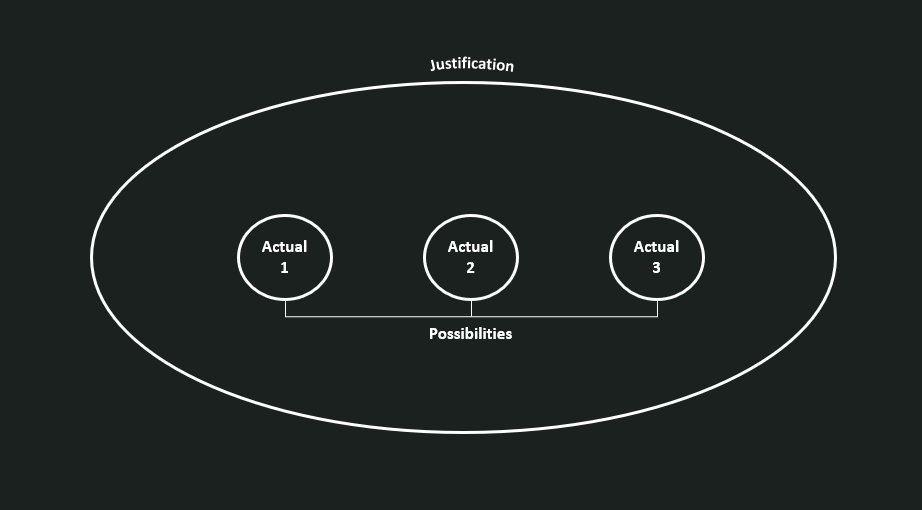
This also reflects knowledge. Knowledge is constructed in many different forms but all funnels to objective truth much like everything in the universe is governed by gravity. Natural law or natural right – much like natural truth – does not come from a sage or a hierarchical structure either from government or royalty. It is the innate concept that makes way for government to form within an anti-foundationalist structure. Epistemology, or the origin of knowing, is not a one size fits all, not everyone through their experiences conceptualize knowledge in the same way, with that said all experiences funnel to knowing an objective truth about the universe as an eventuality in the course of knowledge both through discernible and indiscernible characteristics.
References
Chisholm, R. (1967). Identity through possible worlds. Noûs, 1(1), 1-8. https://www.jstor.org/stable/2214708

 carsonbabich.com
One thought on “Chisholm’s Paradox (1967) Towards an Objective Concept of Epistemic Truth”