
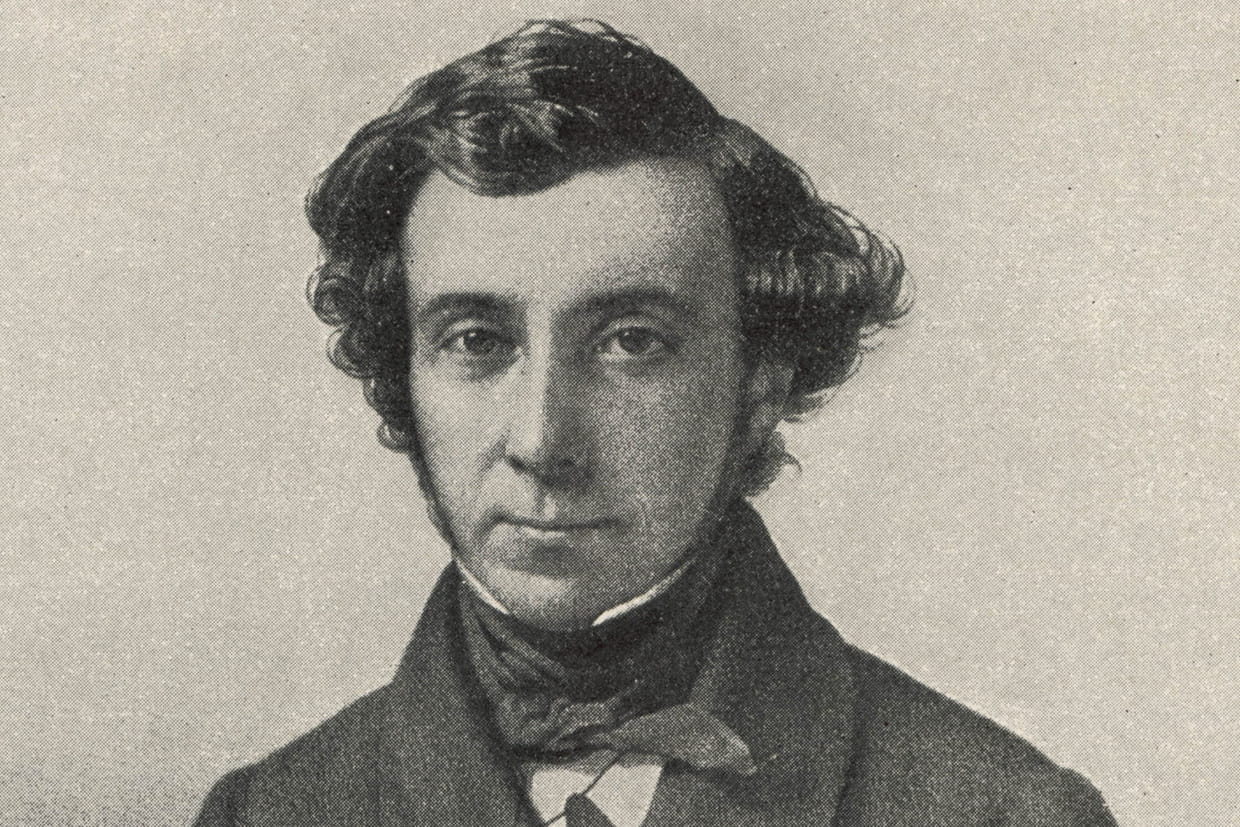
It may be pervasive to consider an outsider might supplant an idea about a society that is not theirs, alas, that pervasive idea is not any sort of theory or science, therefore the benefit of an outsider viewing a blind spot of a society produces a benefit. This leads to Alexis de Tocqueville and my interest towards his ideals on America. I cannot help but relate my keenness of American culture, history, pop culture, politics, and society to critique the view of what I feel is still the worlds most preeminent power.
Tocqueville was a French aristocrat, diplomat, and political scientist who is considered in the frame of centrist politics and classical liberal ideals. In this composition, I would like to focus on three important works to get a view of Tocqueville’s concepts on politics, society, and ethics. Furthermore, I would like to assess Tocqueville’s ideals of learning and epistemology given my profession and see how this might have influenced his ideals in his writings. This may provide an insight to his influential works and why he is highly regarded in the pantheon of American politics. The three works I would like to look at are:
- Democracy in America (1899/1835)
- Memoir of Pauperism: Does Public Charity Produce an Idle and Dependent Class of Society? (2005/1835)
- The Recollections of Alexis de Tocqueville (1896/1850)
Some of the most influential sections of Tocqueville’s writing has to do with understanding leadership and power within government. Understanding the need of power, but majority power in the liberal sense of natural rights for every individual human. Key implications in his work relate to freedoms to which he states in Democracy in America
“It is not only the fortunes of men which are equal in America; even their requirements partake in some degree of the same uniformity” (1899/1835 p. 39).
Democracy in America focuses on two freedoms: assembling of the population and the press as stated in the Constitution of the United States. This is a stark contrast to the feudalism in his home of France prior to the revolution and his immense focus on media being the gatekeeper is important to his conception of freedom.
“I have already observed that, from their origin, the sovereignty of the people was the fundamental principle of the greater number of British colonies in America. It was far, however, from then exercising as much influence on the government of society as it now does. Two obstacles, the one external, the other internal, checked its invasive progress. It could not ostensibly disclose itself in the laws of colonies which were still constrained to obey the mother-country: it was therefore obliged to spread secretly, and to gain ground in the provincial assemblies, and especially in the townships.” (1899/1835, p. 44)
He warns of tyranny and the issue of royalty as a proxy for the white tyranny of blacks and natives at the time, he had forethought as this was before the civil war. He also introduces a potential challenge with tyranny coming from industrial despotism seen as a warning of capitalism over ten years before the manifesto of Marx and Engels.
Although Tocqueville does not imply a revolution towards the capitalist system and a dismantling. He asks for a balanced order considering his Memoirs of Pauperism reflect this challenge of charity in England stemming from the Old Poor Laws of Elizabeth I in 1601, and Lord Melbourne’s New Poor Law in 1834.
Tocqueville outlines the issues of the welfare system as a gateway to tyranny through the problems of idle hands and the reliance of government control leading to tyranny like his analysis in Democracy. He outlines permanent charity forces high taxation being a detriment to the working class.
“Any measure which establishes legal charity on a permanent basis and gives it an administrative form thereby creates an idle and lazy class, living at the expense of the industrial and working class.” (2005/1835 p. 30)
His Recollections consider his view on self-centered bureaucrats attempting to create government will only produce further unrest. He attempts to enlighten us of the potential that come from that power structure:
“It would, in fact, be a great mistake to think that the Tsar’s immense power was only based upon force. It was founded, above all, on the wishes and the ardent sympathies of the Russians. For the principle of the sovereignty of the people lies at the root of all government, whatever may be said to the contrary, and lurks beneath the least independent institutions.” (1896/1850, p. 339)
I recently wrote an article on the SOHO debate between capitalism and socialism as economic structures where both respective defendants felt the other was tyrannical. Tocqueville cuts through that and warns us and teaches of the potential of tyranny from all sides when dependent on a government or a business. This is a true classical liberal approach relating to the democracy of material wealth leading to a reliance on the state creating despotism.
The common theme relating towards tyranny of an overburdening government and a consistent reminder of naturalism and classical liberal values to avoid tyranny. He wants us to continue to question leaders by explaining their motives returning to the freedom of the populist and the important role populism has in knowledge on political discourse. Moving forward, I would like to look deeper into his works as I find them strikingly interesting, and strikingly relevant.
References
De Tocqueville, A. (1899). Democracy in America (H. Reeve, Trans.), D. Appleton and Co. (Original work published 1835).
De Tocqueville, A. (2005). Memoir on pauperism: Does public charity produce an idle and dependent class of society? Cosimo Classics. (Original work published 1835). De Tocqueville, A. (1896). The recollections of Alexis de Tocqueville (A. Teixeira de Mattos, Trans.), Macmillan. (Original work published 1850).
De Tocqueville, A. (1896). The recollections of Alexis de Tocqueville (A. Teixeira de Mattos, Trans.), Macmillan. (Original work published 1850).

 carsonbabich.com
One thought on “Short Composition on Alexis de Tocqueville”